Before buying critical illness insurance, put a recovery budget on paper


A recovery budget examines how a serious illness can affect household finances. Income and expenses can change even when treatment is publicly funded. Time away from work, a partner’s reduced hours, travel and help at home can change what the household earns and spends. The amount and duration vary widely; they should be estimated before choosing an insurance benefit.[1]
Critical illness insurance can provide a lump sum for a condition that meets the contract’s definition and other claim requirements. Whether it belongs in a particular plan depends on the financial need, existing resources, policy terms and ability to keep paying for it.
How much critical illness insurance do you need?
A salary multiple cannot establish a suitable amount for every household. A recovery budget starts with the expenses and income changes in a clearly stated scenario, subtracts resources actually available for that purpose and tests different recovery lengths. The result describes an assumed funding gap, not a recommended policy amount.[1]
A quoted benefit also needs to be tested against the policy’s covered-condition definitions and claim requirements. A budget shortfall and a payable insurance claim are separate findings. A personal recommendation requires both a needs analysis and a review of the actual coverage.
Which costs belong in a recovery budget?
Begin with ordinary housing, utilities, food and debt payments. Then consider which costs might fall, such as commuting, and which might rise, such as parking for appointments or temporary help with care. Estimate the possible change in each person’s income. Unpaid care from a relative also uses that person’s time and may affect their earnings.[1]
A recovery budget worksheet can help organize that inventory. It cannot establish the cost of a future illness or prove that a particular insurance amount is needed. Use a range where the duration or cost is uncertain.
Hypothetical recovery budget: essential household expenses are $4,500 a month. Assume $3,200 of spendable income continues, leaving a $1,300 monthly shortfall. Over six months, that totals $7,800. Add an assumed $2,400 for travel and $1,800 for temporary help at home: the total is $12,000. If $5,000 of savings is available specifically for this scenario, the remaining assumed funding need is $7,000.
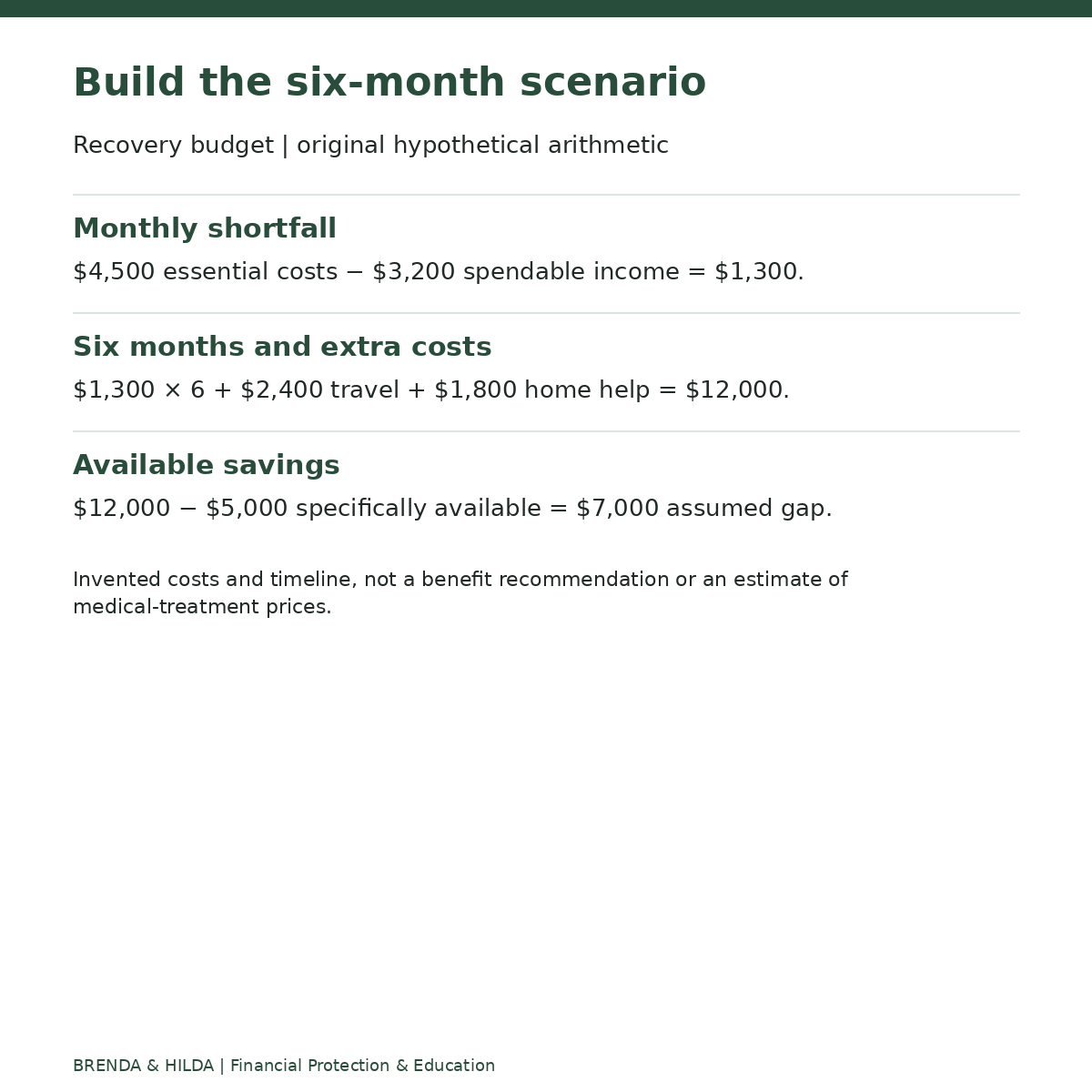
The calculation ignores changing prices and many possible circumstances. It is not a recommendation for a $7,000 policy or a prediction of treatment costs. A longer recovery, lower benefit payment or a partner’s lost earnings would change it.
Which resources belong in a recovery budget?
Review workplace disability benefits, individual coverage, paid leave and emergency savings. Identify start dates, tax treatment and offsets before recording a spendable amount. A disability benefit estimate should not assume approval merely because a critical illness has been diagnosed.[1]
Keep savings already assigned to a mortgage payment or an emergency from being counted again for recovery. If drawing on an RRSP is part of a scenario, include the possible tax cost. Borrowing should appear as debt with a repayment obligation, not as an existing benefit.
Does the recovery budget assume a qualifying claim?
Disability insurance generally responds to an inability to work under its definition. Critical illness insurance responds to specified medical conditions and other requirements. Neither covers every possible reason the household might lose income.[1]
Read the covered-condition definitions, exclusions, survival requirement and any initial exclusion period. A broad list of illnesses cannot tell you whether a particular early-stage condition qualifies. Optional partial benefits and return-of-premium provisions also have conditions. The AMF’s consumer guidance explains these differences; the specific contract determines the benefit.[2][3]
Is critical illness insurance worth it for every household?
A policy needs to remain affordable when no claim is happening. Ask whether premiums are guaranteed, when they can increase, when coverage ends and what is returned, if anything, on cancellation. Compare a plain policy with optional riders using separate prices and benefits.
Before a needs-analysis meeting, gather the benefit booklet, existing insurance schedules and a monthly expense total. You can bring approximate figures initially without sending medical records through a website form. The advisor can then explain which parts remain uncertain and what additional information is needed before any product recommendation.
A recovery budget needs the right provincial resources
The assumed monthly expenses and six-month recovery period above are not an Ontario estimate or a national average. Public coverage, work arrangements and the ability of a relative to take leave can change the budget. A quoted insurance amount cannot establish those resources.
For Alberta, British Columbia, Manitoba, New Brunswick, Newfoundland and Labrador, Nova Scotia, Ontario, Prince Edward Island, Saskatchewan, Northwest Territories, Nunavut and Yukon, CPP disability may be relevant if its contribution and severe-and-prolonged conditions are met. Quebec has QPP disability, with its own criteria. Neither program is simply a temporary recovery fund available after every serious diagnosis. Official CPP eligibility.
EI sickness remains a federal program, including for eligible Quebec claimants. Leave rights should be checked through the official province-and-territory workplace directory, or the federal rules if the employer is federally regulated. Where a partner plans to reduce hours, record the actual leave and expected income rather than assuming paid leave is identical across Canada.
The budget should use confirmed benefits after coordination and applicable tax. Quebec’s wage-loss replacement rules require separate attention to Quebec deductions. A personal recommendation still needs the household’s circumstances and the specific contract; the provincial comparison is background education.
How do you start a recovery budget when costs are uncertain?
Choose a clearly labelled scenario and record what you know today. Keep ordinary household costs, extra recovery costs and income changes on separate lines. Use a range where a figure is uncertain and note who can confirm it. For example, parking costs may be estimated from planned appointments while the length of an absence remains unknown. A recovery budget is more useful when those assumptions are visible than when one total appears precise. Keep the date of the estimate so the household can update it when circumstances change.
How does the recovery budget change over three, six or twelve months?
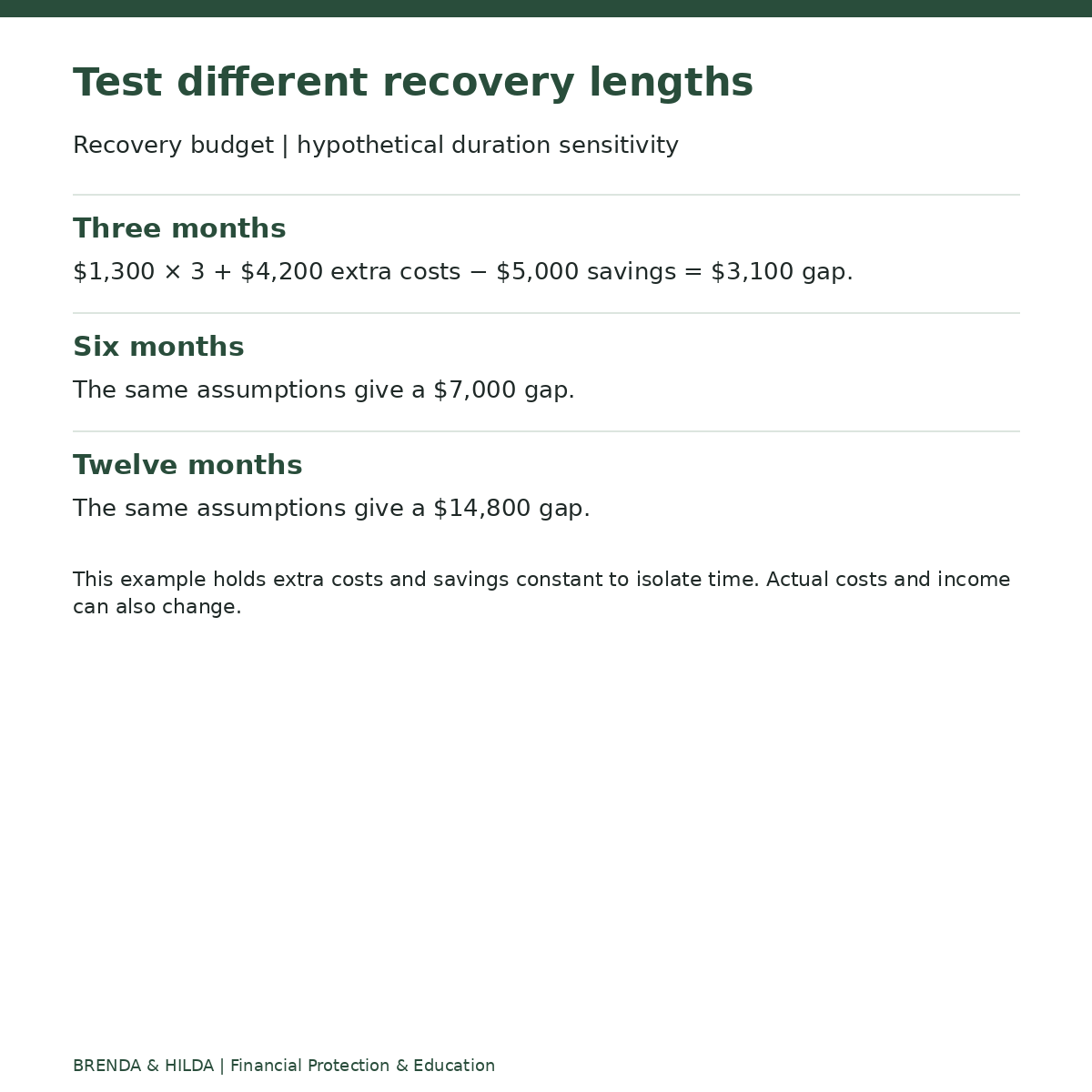
Use the same assumptions first so the effect of time is visible. In the example above, the $1,300 monthly shortfall becomes $3,900 over three months, $7,800 over six and $15,600 over twelve. If the assumed $4,200 of travel and home-help costs stays unchanged across those scenarios, the totals are $8,100, $12,000 and $19,800. Subtracting the same $5,000 savings leaves $3,100, $7,000 and $14,800. These are invented sensitivity calculations. In reality, travel and care costs may also grow with time, and income may recover unevenly.
How do you include a caregiver in a recovery budget?
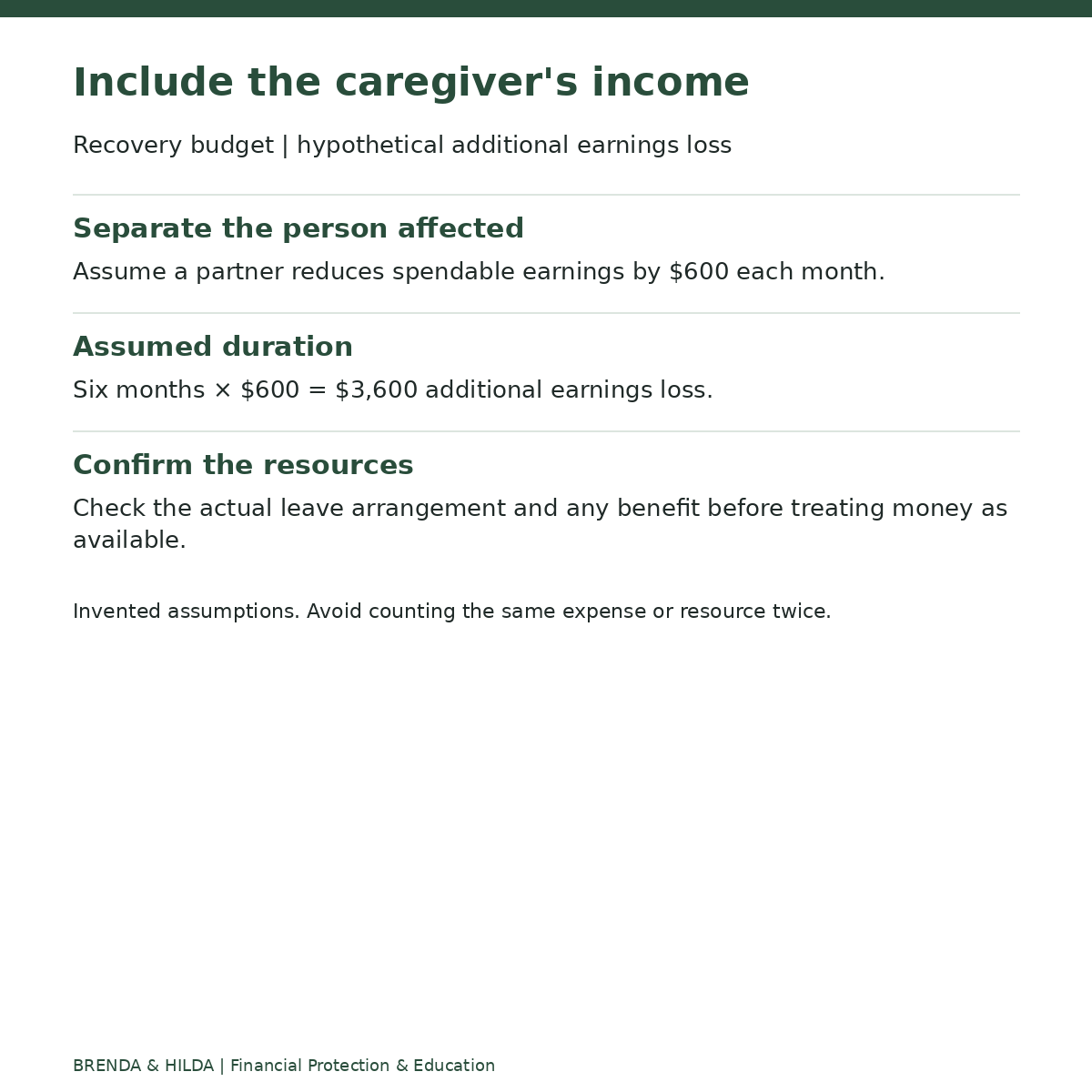
Record the caregiver’s possible income change separately from the patient’s. An invented $600 monthly reduction in a partner’s spendable earnings over six months adds $3,600 to the assumed funding gap. It does not tell you whether the partner can take leave, whether any public or employer benefit applies or whether the person will actually lose that amount. Ask the relevant administrator about those resources. Also list which household tasks would need help if the usual unpaid caregiver is receiving treatment. Avoid assigning both lost wages and replacement-service costs to the same task without explaining the assumption.
What if some savings are already committed?
Use only the amount available for this recovery budget. Suppose the household has $8,000 in its account but $3,000 is committed to an upcoming bill that is not included in the scenario. That leaves $5,000 for the recovery calculation. Treating the full account balance as available would understate the assumed shortfall by $3,000. If the bill is already included elsewhere in the budget, reconcile it rather than subtracting it twice. The purpose is to track the same dollars consistently, not to infer that a particular insurance amount is required.
How should a recovery budget record an uncertain benefit?
Use separate columns for confirmed, estimated and unconfirmed resources. A policy’s face amount is not confirmed cash for a particular illness until the relevant claim requirements are met. A government program has its own eligibility decision. For each potential payment, record the source, application or review status, expected timing if known, and the person who can answer questions. Keep a scenario without that payment beside one that assumes it. That comparison makes uncertainty visible while avoiding a prediction about the claim outcome.
When should you update the recovery budget?
Review the worksheet when income, household costs, employer benefits or the expected recovery timeline changes. Save the earlier version with a date so changes can be explained. Bring the current recovery budget and supporting benefit documents to a needs-analysis meeting. Approximate figures can start a conversation, but personal recommendations require the relevant facts and actual contract terms. The worksheet can also identify questions to ask an employer, insurer or public-program administrator. It should not become a substitute for their eligibility or benefit decisions.
Sources
[1] AMF, How to choose critical illness insurance; FCAC, Disability insurance; CRA, RRSP withdrawal tax treatment. The recovery budget is an original hypothetical calculation.
[2] AMF, critical illness insurance.
[3] AMF, how to choose critical illness insurance. Contract mechanics are discussed generally; Ontario advice remains subject to an individual needs analysis.
About your advisor
Brenda Nkwocha and Hilda Chukwu are licensed life insurance advisors in Ontario. Personal recommendations and quotes follow a separate needs analysis. This article provides general education, not personalized advice, a quote or a guarantee.
Choose a starting point that fits your situation.
Answer a few questions about your existing arrangements and what to check. A summary is not a needs analysis or a recommendation.