Critical illness insurance: why a diagnosis may not trigger a payment


Critical illness insurance applies a contractual test to a medical condition. A diagnosis is a medical finding. An insurance claim also has to meet the definition written into the policy. Critical illness coverage can pay a lump sum for a covered condition, but the diagnosis label alone may not establish entitlement.[1]
The gap between those two tests is important when a brochure lists familiar words such as cancer, heart attack or stroke. A contract may specify types, severity, evidence and exclusions within a listed condition. Two policies with the same number of listed conditions can therefore provide materially different coverage.
Does critical illness insurance cover cancer?
Cancer is commonly a covered condition, but the policy defines which forms and stages qualify. Certain early-stage conditions may be excluded from the full benefit or covered only by a partial benefit. A cancer diagnosis therefore needs to be compared with the complete contractual definition, including exclusions and timing provisions.[2][3]
That is why the number of illnesses in a brochure cannot settle how a policy would respond. The relevant wording is the definition for the condition being claimed, together with the evidence and other requirements attached to it.
Read the complete definition
The relevant provision may require confirmation by a specified specialist or particular clinical findings. Certain early-stage or less severe conditions may be excluded from a full benefit, or qualify only for a separate partial benefit. Product names and condition counts cannot show those differences.[1][2]
Hypothetical example: two people receive diagnoses that both fall under a broad everyday description of cancer. One condition satisfies the assumed policy’s covered-cancer definition. The other falls within an explicit exclusion for a particular early-stage condition. The first may qualify for a full benefit and the second may not. Whether a partial benefit exists depends on that contract. This is an illustration of how definitions operate, not a clinical description or a prediction about a real diagnosis.
Ask the advisor to show the actual definition and explain a covered scenario and an excluded scenario using that wording. Obtain the specimen contract before deciding, rather than relying on the list on the application screen.

When does critical illness insurance pay out?
A survival period is the period the insured must survive after the specified diagnosis or event to qualify. An initial exclusion or moratorium provision can instead limit coverage for a condition arising around the start of the contract. These provisions perform different jobs.[1][2]
Hypothetical example: a specimen policy has an assumed 30-day survival requirement. Meeting the medical definition on the diagnosis date would not, by itself, satisfy that additional requirement. In a separate clause, the same hypothetical policy excludes specified cancer claims connected with symptoms or investigation during its initial exclusion period. The later diagnosis date may not resolve that exclusion if the clause also refers to earlier symptoms or consultations.
The AMF describes 30-day survival requirements and initial cancer-related periods as examples found in the market. They are not universal rules. The length, trigger, exceptions and reporting obligations must come from the policy being considered.[2][3]
The benefit serves a different role from disability insurance
Disability insurance generally tests an inability to work under its contractual definition and pays an income benefit. Critical illness insurance tests a covered condition and other claim requirements. Someone can qualify for disability benefits without having a listed critical illness. Someone with a qualifying critical illness may remain able to work.[1]
Once payable, an unrestricted critical illness lump sum can be used for household costs, caregiving or other priorities. Payment does not necessarily depend on submitting receipts for those expenses. That flexibility should not be confused with coverage for every illness or a promise that treatment costs will be reimbursed.[1]
Optional refunds have their own conditions
A return-of-premium rider can add cost and may require the policy to remain in force until a specified event or date. Cancelling early can produce a different result. Compare the additional premiums with the contractual refund, the time before eligibility and the effect of a prior claim.[1][3]
Before buying, obtain written answers about definitions, timing, exclusions and partial benefits. A personal recommendation also needs an assessment of existing coverage, savings and ongoing affordability. A broad medical label cannot supply that analysis.
Do covered illnesses depend on the province?
The policy’s definitions determine whether a cancer, heart attack, stroke or other condition qualifies. Publicly funded treatment and an insurance benefit are different arrangements. Receiving care through a provincial health plan does not, by itself, establish that a critical-illness contract must pay. Nor does the number of conditions listed in a policy establish a different benefit in each province.
Across Alberta, British Columbia, Manitoba, New Brunswick, Newfoundland and Labrador, Nova Scotia, Ontario, Prince Edward Island, Quebec, Saskatchewan, Northwest Territories, Nunavut and Yukon, obtain the actual covered-condition wording, exclusions and claim procedure. Local insurance law and the licensed representative’s authority still matter. The official regulator directory identifies the relevant jurisdiction; AMF consumer explanations used here describe product mechanics and are not a statement of every province’s law.
Provincial treatment coverage can affect the household’s recovery budget, but this article does not assume that travel, drugs or home care are funded identically everywhere. That budget belongs alongside existing workplace benefits and the relevant public programs. The recovery-budget article separates a possible expense from an insurance claim that actually qualifies.
Does a larger critical illness insurance benefit guarantee a better outcome?
The amount is only useful when the claim qualifies and the payment arrives when the household can use it. Consider two invented contracts with the same $50,000 stated benefit. Assume one pays the full benefit for a particular qualifying event and the other pays a separate $5,000 early-stage benefit for that event. Those assumptions produce different payments even though both brochures show $50,000. They say nothing about real products. Ask which definition, partial-benefit provision and policy-continuation rule applies before treating either amount as available cash.
How can you compare two critical illness insurance quotes?
Build the comparison around one clearly described assumption at a time. Put the insured person, coverage amount, premium schedule, expiry date and relevant riders in separate columns. Then ask the representative to point to each answer in the actual contract. If one quote includes a refund rider and the other does not, record that difference before comparing totals. A lower first-year premium does not answer the cost over the intended holding period. Keep an unexplained item marked unknown instead of filling it with an assumption from the competing policy.
What does an optional refund cost in a simple example?
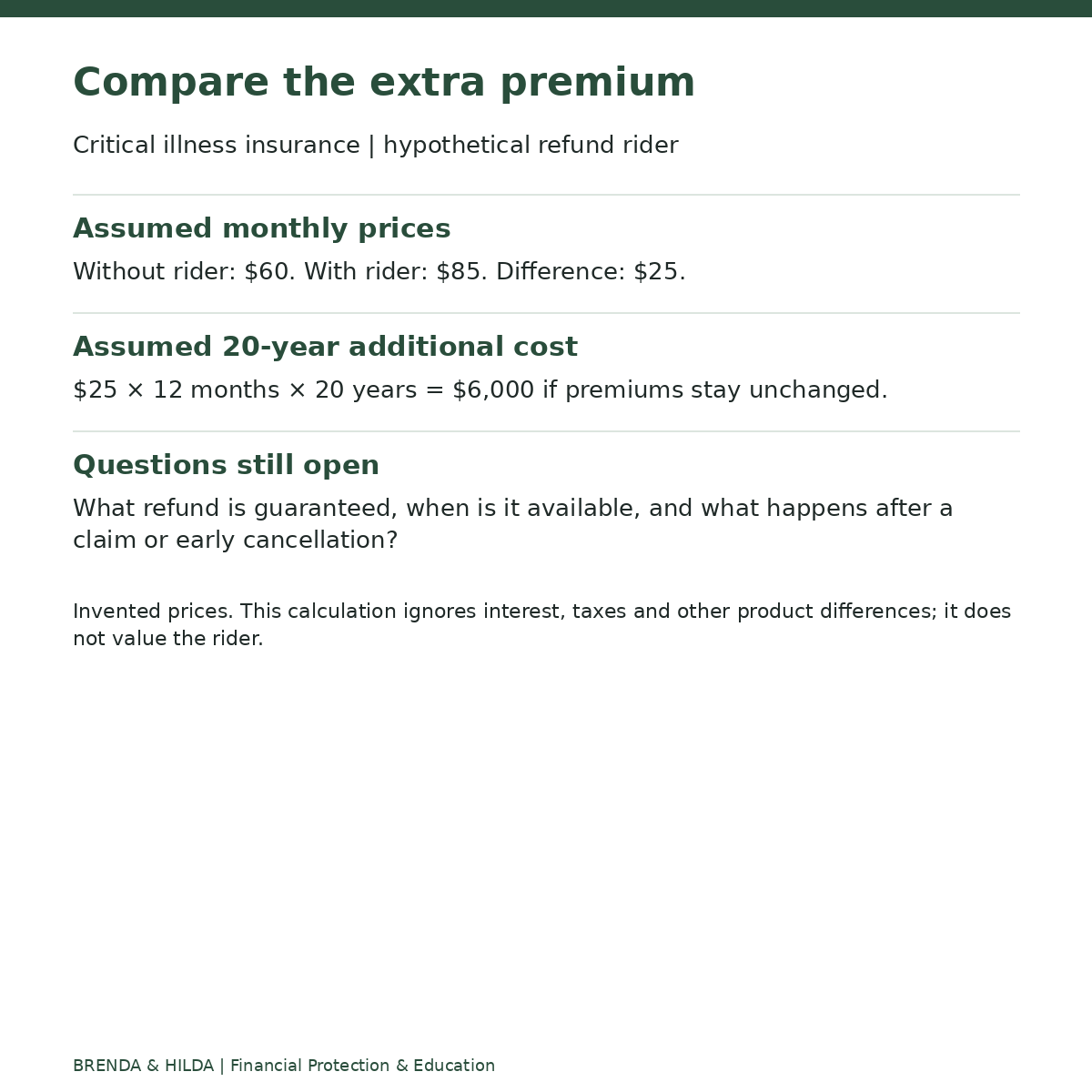
Hypothetical example: suppose one version of a contract costs $60 a month and the version with an optional refund provision costs $85. The difference is $25 a month, or $300 a year. Over an assumed 20 years of unchanged premiums, that is $6,000 in additional premiums. This arithmetic is not the value of the rider. You would still need the exact refund amount, eligible date, claim restrictions and cancellation terms. It ignores interest, tax consequences and the value of other differences between contracts. Compare a written illustration with the guaranteed wording before drawing a conclusion.
What should a household do while a claim is being assessed?
Separate a possible critical illness insurance payment from money already available for bills. For an invented budget, suppose the household has a $1,500 monthly shortfall and $4,500 in accessible savings. That covers three months at that assumed rate, before additional expenses or interest. The calculation does not predict the insurer’s claim-processing time or establish that any benefit will be paid. A practical review records due dates, confirmed resources and unanswered questions together. Keep medical documents in the insurer’s secure process rather than submitting them through this website’s introductory assessment.

Which critical illness insurance documents should you keep?
Keep the issued policy, application, amendments, premium schedule and any decision letters where the owner can access them. Record the insurer’s claim contact and ask what process applies to a potential claim. A specimen contract helps with comparison, but the issued contract and its amendments show the terms actually in force. If a brochure and a policy appear inconsistent, ask for a written explanation. Preserve the explanation beside the clause it addresses so that the household does not have to reconstruct the discussion from memory.
What is the next step before deciding about critical illness insurance?
Start with the existing arrangements and the household’s recovery budget. Identify which income would continue, which costs would change and which amounts remain unconfirmed. List questions for the employer benefit administrator, insurer or licensed representative. The aim is a clear record of the situation before deciding whether to retain, change or purchase coverage. A question left open is useful information; it is not proof that another policy is required. Any personal recommendation needs a separate assessment of the family’s circumstances and the actual options available.
Sources
[1] AMF, Critical illness insurance; AMF, How to choose critical illness insurance.
[2] AMF, critical illness insurance.
[3] AMF, how to choose critical illness insurance. AMF consumer explanations are used for product mechanics, not as a statement of Ontario licensing law.
About your advisor
Brenda Nkwocha and Hilda Chukwu are licensed life insurance advisors in Ontario. Personal recommendations and quotes follow a separate needs analysis. This article provides general education, not personalized advice, a quote or a guarantee.
Choose a starting point that fits your situation.
Answer a few questions about your existing arrangements and what to check. A summary is not a needs analysis or a recommendation.