TFSA, RRSP or FHSA? Follow the money in and out


A tax deduction can look attractive on the day you contribute. The harder question is what happens when you need the money back. A TFSA withdrawal, an ordinary RRSP withdrawal and a qualifying FHSA withdrawal follow different rules, even if all three accounts hold the same investment.
The account name describes a tax arrangement. It does not tell you whether the money is in cash, a GIC or investments that can fall in value. That distinction matters when the money has a fixed deadline, such as a home purchase. Choosing an investment and choosing its tax arrangement are separate decisions.[1]
Can you have a TFSA, an RRSP and an FHSA at the same time?
Yes, if you meet the eligibility requirements for each account. Opening one does not automatically prevent you from using the others. A TFSA and RRSP have separate personal contribution limits. An FHSA has its own participation room, although an RRSP-to-FHSA transfer uses that room and does not create a second deduction.[2][4][5][7]
Having all three does not establish which to fund first. Money needed soon, available contribution room and the tax treatment of the eventual withdrawal can lead to different decisions. An account can hold an investment that falls in value even when its withdrawal is tax-free. The tax arrangement and the investment inside it need separate examination.[1]
A TFSA gives withdrawals more flexibility
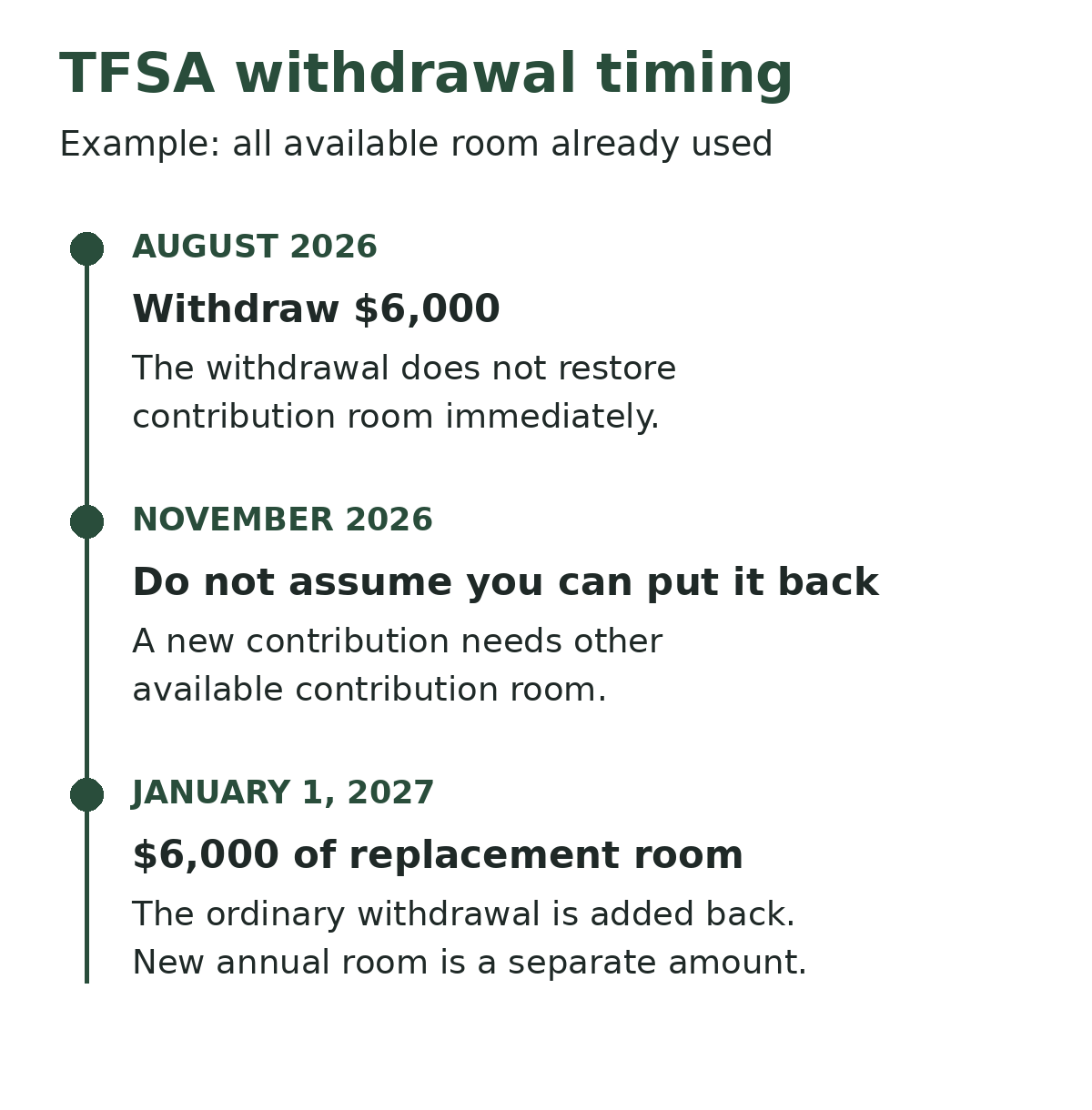
TFSA contributions are not deductible. Investment income and withdrawals are generally tax-free, and a withdrawal normally creates replacement contribution room on January 1 of the next calendar year. It does not immediately restore room in the year you take the money out.[2]
Hypothetical example: Amara has used all her available TFSA contribution room. She withdraws $6,000 in August 2026 for a repair. The withdrawal adds $6,000 to her room on January 1, 2027. Putting it back in November 2026, without other available room, would create an excess contribution. The next year’s new annual room is a separate addition.
The 2026 annual TFSA dollar limit is $7,000. Your personal available room may be higher because of unused room and prior withdrawals, or lower because you have already contributed. Multiple TFSAs share one personal limit. Reconcile your own transactions across institutions; an account balance is not a contribution-room statement.[2][3]
How many TFSAs can you have, and where do you check the room?
You can hold more than one TFSA, but opening another account does not give you another annual allowance. The useful number is the room available across all of your TFSAs together. A bank can show the transactions it handled without knowing everything that happened at another institution. Before moving money, bring the records together rather than treating each account as a separate limit.
Start with your available room at the beginning of the year and subtract the contributions made since then. A regular withdrawal during this year normally becomes replacement room next January, rather than immediately. CRA account information can lag behind transactions, so check it against your own statements. If the figures disagree, identify the missing deposit or withdrawal before contributing. Keep a dated calculation with the statements that support it. See CRA’s contribution-room calculation.
Can you transfer a TFSA from one bank to another?
Yes. A direct transfer arranged through the financial institutions is different from withdrawing the money yourself and depositing it in another TFSA. With a qualifying direct transfer between your own TFSAs, the movement does not use contribution room. If you handle it as a withdrawal and a new contribution, the second deposit uses the room currently available to you. That difference can matter even when the same amount leaves one account and enters the other on the same day.
Ask the receiving institution how it will request the transfer, what fees apply, and whether the investment can move in kind or must first be sold. A direct transfer preserves the account’s tax treatment; it does not remove an existing excess contribution or make every investment transferable. Keep the transfer confirmation. A statement showing money leaving an account is not, on its own, proof that the transaction was recorded as a direct transfer. See CRA’s TFSA transfer guidance.
Does an investment loss give you more TFSA contribution room?
No. A fall in the value of investments inside a TFSA is not a withdrawal and does not create replacement contribution room. Imagine a hypothetical account funded with $10,000 that falls to $7,000. The $3,000 decline does not let the holder deposit an extra $3,000 without other available room. Selling the investment inside the TFSA also does not turn the decline into a withdrawal.
If the holder instead withdraws the remaining $7,000, the ordinary withdrawal amount is what is added back the following year, subject to the applicable rules. The original $10,000 contribution is not automatically restored. This is one reason to separate the tax arrangement from the investment risk. A tax-free account cannot prevent an investment loss, and an account balance cannot tell you the amount you may legally contribute. See CRA’s explanation of investment losses and room.
What happens if you over-contribute to a TFSA?
An excess TFSA contribution can trigger tax of 1% per month. CRA tells holders to remove an excess promptly rather than wait for a letter. Correcting the account and dealing with any return or tax owing are separate steps. Do not assume that a later withdrawal erases the tax already triggered, or that moving the same excess to a different TFSA solves the problem.
Reconcile the dates and amounts across every TFSA and establish when the excess first arose. Keep evidence of the correction and check whether a TFSA return is required. If you think relief may apply, review CRA’s conditions rather than assuming a mistake will automatically be forgiven. The correction itself can affect later room calculations, so a simple account-balance comparison may be insufficient. See CRA’s steps after an over-contribution.
Why can TFSA excess tax apply after a quick correction?
The excess tax is generally based on the highest excess TFSA amount during each affected month. In a simplified hypothetical example, a $2,000 excess that exists during one month produces $20 of excess tax for that month. If the same $2,000 excess continues into a second month, the two-month total would be $40. Removing it before month-end does not automatically make the first month disappear.
These examples assume Canadian residence, no other excess amounts, and no further transactions. They are not a calculation for someone who has several deposits, withdrawals or a residency change. Build a transaction timeline before relying on an estimate. CRA provides worked excess-tax examples showing why dates matter.
An RRSP shifts tax to a later withdrawal
An eligible RRSP contribution can reduce taxable income when deducted. Growth is generally sheltered while it stays in the plan; an ordinary withdrawal is generally taxable. Withholding at withdrawal is a payment toward tax, and the final liability depends on the tax return. Ordinary withdrawals generally do not restore contribution room.[1][4]
Hypothetical example: a deductible $5,000 contribution reduces tax by $1,500 if the whole deduction falls at an assumed 30% marginal rate. A later ordinary $5,000 withdrawal generates $1,500 of tax if the same assumed rate applies then. This simplified calculation ignores investment returns and other tax interactions. It explains tax deferral; it does not predict either person’s future tax rate.
For 2026, the RRSP dollar ceiling is $33,810. That is not everyone’s allowance. Earned income, pension adjustments, carryforward room and other adjustments determine the personal limit. Check your latest CRA notice and subsequent contributions. Special programs, including the Home Buyers’ Plan, have separate eligibility and repayment rules.[3][4]
Is RRSP withholding the full tax on a withdrawal?
Not necessarily. The institution withholds tax when an ordinary RRSP withdrawal is paid, but the withdrawal must still be reported on the income tax return. The final result depends on the person’s total income, deductions, credits and applicable provincial or territorial tax. A smaller amount withheld at the bank does not establish that less total tax will ultimately be owed.
CRA publishes federal withholding rules, including a separate federal schedule for Quebec, where provincial withholding must also be considered. For Alberta, British Columbia, Manitoba, New Brunswick, Newfoundland and Labrador, Nova Scotia, Ontario, Prince Edward Island, Saskatchewan, Northwest Territories, Nunavut and Yukon, the regular outside-Quebec schedule applies to these resident withdrawals. The final combined tax calculation still varies by jurisdiction and circumstances. Residency outside Canada is a separate case. Check CRA’s withdrawal-tax guidance before interpreting a net payment.
Is changing RRSP providers the same as cashing out?
No. A direct transfer from one RRSP to another is generally treated as a transfer rather than a withdrawal. Taking money out personally and then putting it into a new RRSP can instead involve taxable income and a new contribution. The words used in a banking app are less important than how the institution records the transaction.
Confirm the transfer instructions, investment restrictions, fees and expected processing time with both institutions. Special arrangements, including spousal and locked-in plans, can require different checks. Preserve the paperwork showing the type of transfer completed. Do not assume that a new deposit cancels the tax effect of an earlier withdrawal. See CRA’s RRSP withdrawal and transfer overview.
How is an FHSA different from an RRSP?
An eligible first-time home buyer can generally deduct FHSA contributions and make a tax-free qualifying withdrawal. The opening-year participation room is $8,000, the ordinary lifetime contribution/transfer limit is $40,000, and unused participation-room carryforward is limited. Room begins after the first FHSA is opened. Eligibility to open an account and eligibility for a qualifying withdrawal have distinct tests.[5][6]
An RRSP-to-FHSA transfer uses FHSA participation room and does not generate another deduction. If a qualifying purchase does not happen, a permitted direct transfer to an RRSP or RRIF can generally defer tax without using ordinary RRSP room; closing deadlines and excess amounts still need attention. Simply taking out cash is a different transaction.[6][7]
Before choosing an account, identify the purpose and withdrawal date. Then establish the room actually available, the tax consequences of getting the money out and how much investment fluctuation the deadline can accommodate. A tax professional can help where income, home ownership or residency makes those questions complicated.
Can you move TFSA savings into an FHSA?
You can use money withdrawn from a TFSA to make an FHSA contribution if you are eligible and have FHSA participation room. The movement is not a special tax-deferred transfer between the two account types. CRA treats it as a TFSA withdrawal and a new FHSA contribution. The TFSA replacement-room timing and the FHSA contribution limit therefore both need checking.
A hypothetical $4,000 TFSA withdrawal followed by a $4,000 FHSA contribution uses $4,000 of available FHSA room. It does not immediately put $4,000 back into the TFSA’s available room. An RRSP-to-FHSA direct transfer follows another route: it uses FHSA room without creating an additional deduction for the transferred amount. Ask the institution to identify the transaction before it is processed, rather than assuming all transfers receive the same treatment. See CRA’s transfers-into-an-FHSA guidance.
Do FHSA contributions follow the RRSP first-60-days rule?
No. The FHSA contribution period is the calendar year. Contributions made in the first 60 days of a year cannot be deducted for the preceding year in the way an eligible RRSP contribution may be. An FHSA contribution and the decision about when to claim an available deduction are also different matters; eligible unused deductions may be carried forward.
For a hypothetical January 2027 FHSA contribution, do not assume that the RRSP tax-season rule makes it a 2026 FHSA contribution. Keep the receipt and distinguish the contribution year, available participation room and deduction year. A transfer from an RRSP does not become a deductible FHSA cash contribution simply because the money arrived during tax season. See CRA’s FHSA deduction rules.
Does buying a first home automatically make an FHSA withdrawal tax-free?
No. Opening an FHSA and making a qualifying withdrawal have separate eligibility tests. CRA’s conditions address the written purchase or construction agreement, timing, Canadian residence and intended occupancy, among other requirements. A home purchase on its own does not establish that every condition has been satisfied. The institution needs the required withdrawal request; a routine cash withdrawal is not a substitute.
Before requesting funds, check the current conditions against the actual transaction dates. In particular, review the acquisition or construction-completion deadline and the rule concerning a home acquired more than 30 days before the withdrawal. If a purchase changes or falls through, reassess the situation rather than relying on the original plan. Use CRA’s definition of a qualifying withdrawal and the required form.
What happens to an FHSA if you never buy a home?
An FHSA cannot remain open indefinitely. The maximum participation period ends on December 31 of the year of the earliest applicable event: the 15th anniversary of opening the first FHSA, turning 71, or the year following the first qualifying withdrawal. Opening a second FHSA does not restart that clock.
Where the conditions are met, a direct transfer to an RRSP or RRIF can generally preserve tax deferral without using ordinary RRSP deduction room. A cash withdrawal has different consequences. Excess amounts need separate attention. Record the first account’s opening year and review the closing deadline even if home-buying plans are uncertain. See CRA’s FHSA closing rules.
Where TFSA, RRSP and FHSA rules differ across Canada
The contribution and withdrawal rules discussed here come from federal tax legislation. Provincial residence does not create a separate TFSA annual limit or an extra FHSA lifetime allowance. It can affect the age at which an institution can enter into the account contract, and provincial or territorial income tax affects the total cost of a taxable withdrawal. The example using a 30% marginal rate is an assumption, not an Ontario rate or a rate for every province.
| Provinces and territories | Age of majority |
|---|---|
| Alberta, Manitoba, Ontario, Prince Edward Island, Quebec and Saskatchewan | 18 |
| British Columbia, New Brunswick, Newfoundland and Labrador, Nova Scotia, Northwest Territories, Nunavut and Yukon | 19 |
These age groups are listed in the federal government’s age-of-majority table, section 11.6. CRA explains that eligible TFSA room can accumulate from age 18 even where an account cannot be opened until 19. FHSA room works differently: it begins only once the first account is opened. An eligible person who must wait until 19 to open an FHSA does not automatically receive FHSA room for the preceding year. See CRA’s TFSA opening rules and CRA’s FHSA opening rules.
A resident moving between provinces still has one personal contribution-room history across institutions. Taxable RRSP withdrawals require a separate tax calculation for the person’s circumstances; a withholding amount is not a final estimate of combined federal and provincial tax. Quebec residents also file with Revenu Québec. An institution’s opening procedure and the tax rule should therefore be checked separately.
The account’s tax rules do not establish the guarantee on an investment held inside it. The segregated-fund guarantee explanation shows why the investment contract needs a separate review.
Sources
[1] CRA, TFSA contribution room and permitted investments; CRA, RRSPs and Other Registered Plans for Retirement.
[2] CRA, TFSA contribution room and withdrawals.
[3] CRA, annual registered-plan limits.
[4] CRA, RRSPs and other registered plans.
[5] CRA, participating in your FHSAs.
[6] CRA, FHSA withdrawals and transfers out.
[7] CRA, transfers into an FHSA.
About your advisor
Brenda Nkwocha and Hilda Chukwu are licensed life insurance advisors in Ontario. Personal recommendations and quotes follow a separate needs analysis. This article provides general education, not personalized advice, a quote or a guarantee.
Choose a starting point that fits your situation.
Answer a few questions about your existing arrangements and what to check. A summary is not a needs analysis or a recommendation.