Individual pension plans: a retirement promise with a funding obligation


An incorporated owner can hear an individual pension plan described as a way to put more money toward retirement. That leaves out the other side of the arrangement: the employer is establishing a pension promise with funding and administrative obligations. A large first-year contribution figure is only one part of the decision.[1]
An individual pension plan (IPP) generally has a defined-benefit pension provision. The retirement benefit follows a formula, commonly involving eligible earnings and service. Contributions support that promised benefit under pension and tax rules. They are not simply a new personal savings limit that appears when a business owner reaches a particular birthday.[1][2]
How does employment history affect an individual pension plan?
Salary, eligible service, age, existing pension benefits and previous retirement arrangements can affect what a proposed plan provides and what can be funded. Corporate dividends are not pensionable employment earnings in the same way as salary. An actuary needs the actual remuneration and service record before preparing a reliable comparison.[1][2]
Hypothetical example: two incorporated professionals are the same age and their companies have similar revenue. One has a long history of eligible salary and service. The other has mainly received dividends and has little eligible employment history. A funding figure prepared for the first person cannot be copied to the second. The relevant difference is the plan’s eligible earnings and service, not simply business revenue or age.
This example deliberately gives no contribution quote. Without the records and assumptions, a dollar figure would suggest precision the information does not support.
How does an individual pension plan affect RRSP room?
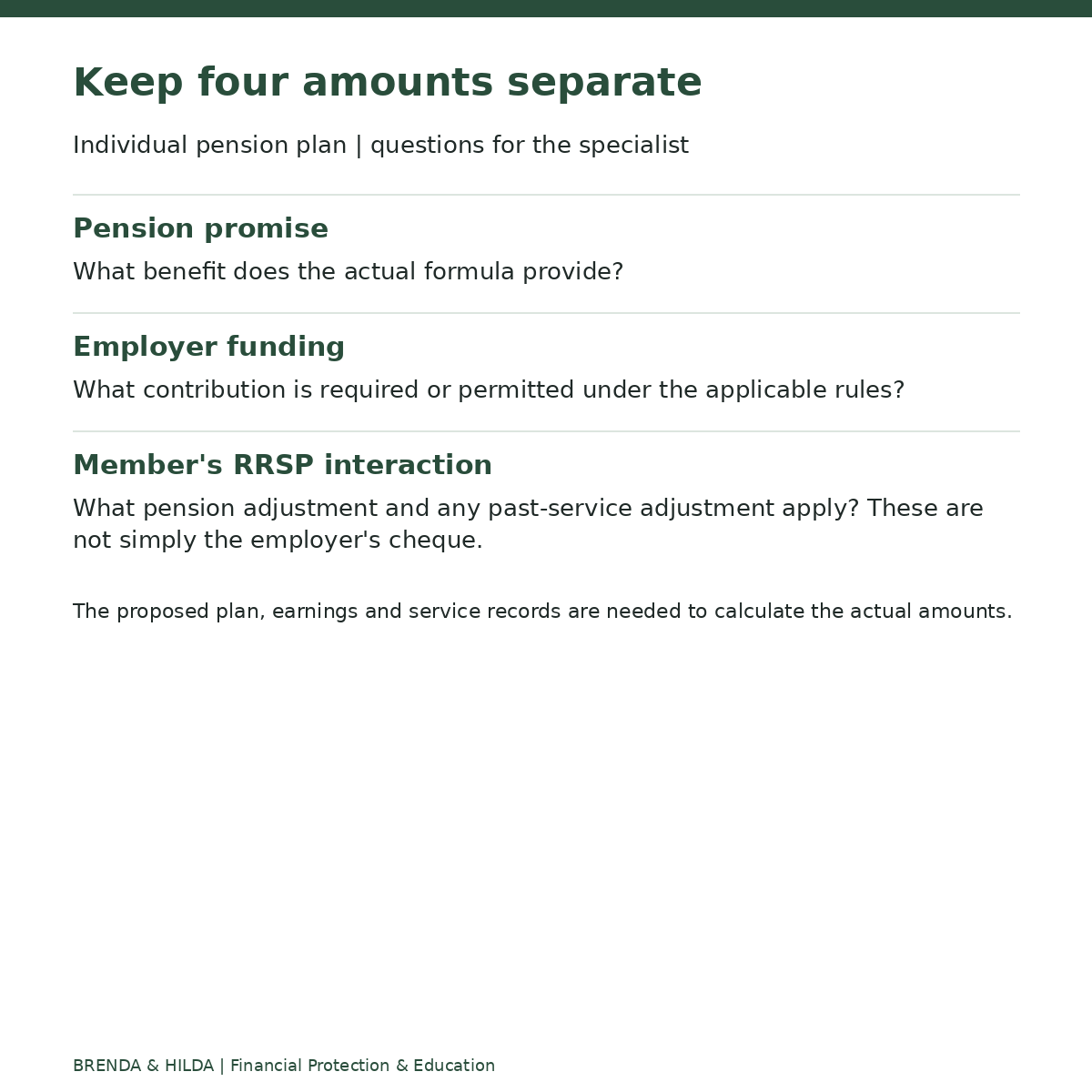
Benefits earned under a defined-benefit provision generally produce a pension adjustment that affects the member’s RRSP room for the following year. The adjustment uses a prescribed benefit-based calculation. It is not necessarily equal to what the employer contributes. Recognizing past service can also produce a past-service pension adjustment, with separate rules.[2]
A proposal should show the pension benefit, employer contributions, pension adjustment and any past-service adjustment separately. Ask the administrator to explain how each affects the person’s existing RRSP and other pension rights. Transferring money from another plan requires its own review; a possible transfer is not permission to bypass registered-plan rules.
Can the company fund an individual pension plan?
Investment performance and actuarial assumptions affect funding. Ongoing valuations, administration, investment costs and regulatory filings can continue after the initial setup. A company that has a strong year today may have different cash needs later.[1]
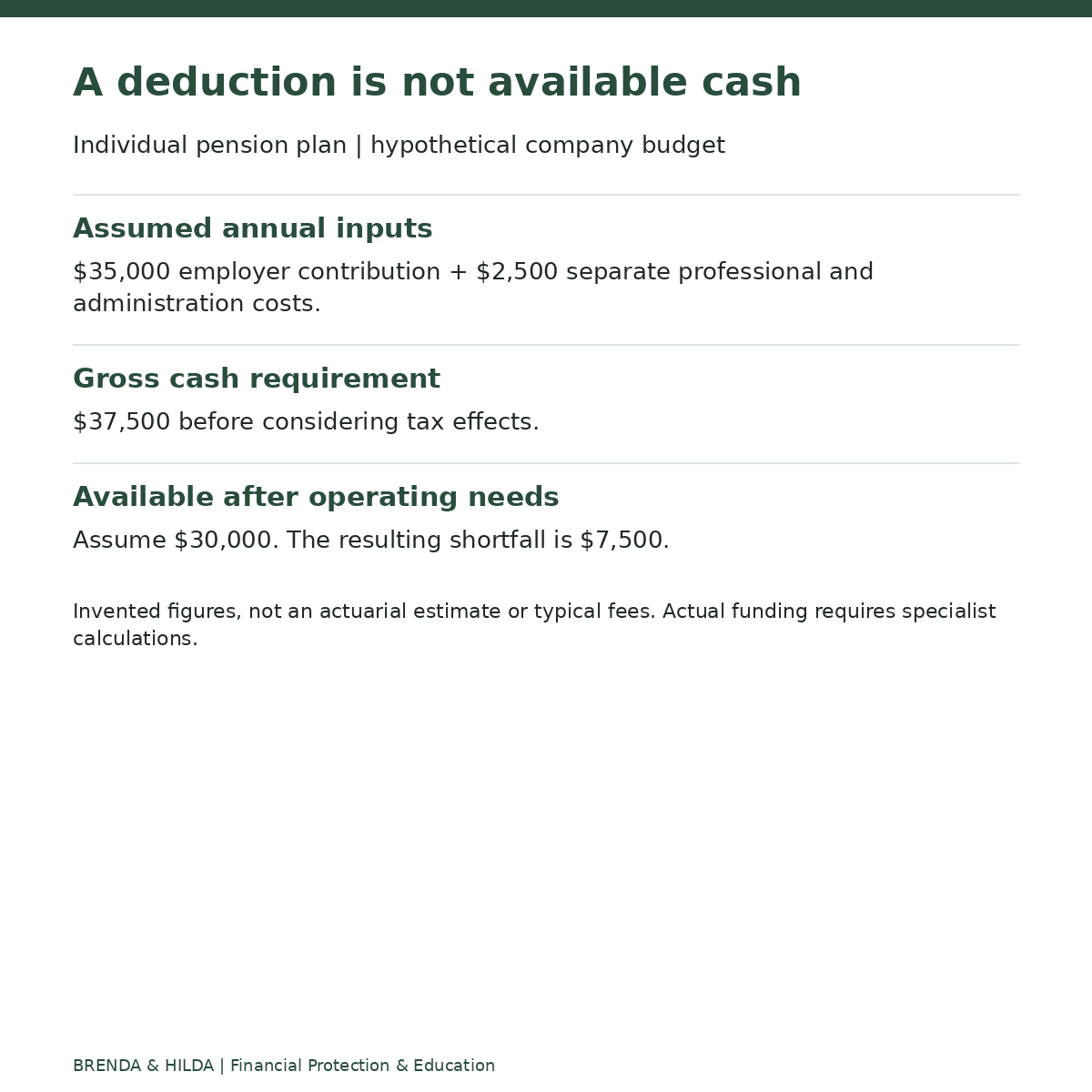
Hypothetical budget illustration: assume a proposed arrangement calls for a $35,000 employer contribution and $2,500 in separate annual administration and professional costs in a particular year. The gross cash requirement is $37,500 before considering tax effects. If the company has only $30,000 available after operating needs, the shortfall is $7,500. These are invented budget inputs, not actuarial estimates or typical fees. A tax deduction does not itself supply the missing cash.
Which Ontario rules apply to an individual pension plan?
Certain IPPs or designated plans involving connected persons may qualify for specific exemptions from Ontario’s Pension Benefits Act. The applicable route depends on when and how the plan was established and who participates. An exemption from Ontario pension standards does not remove federal registered-plan tax requirements.[3]
Creditor protection also requires legal analysis of the actual arrangement. A sweeping comparison claiming that all IPP assets are protected and all RRSP assets are exposed ignores the laws and exceptions that can apply to each.
For an individual pension plan involving a connected person, current-year RRSP room also needs review. CRA notes that room may be reduced in the year a connected person joins a registered pension plan. The general next-year pension-adjustment explanation is therefore not the entire calculation for that person. Ask the plan specialist to show both years and any required filings using the actual records. CRA registered pension plan guide: pension adjustments.
How does an individual pension plan differ from an RRSP?
An individual pension plan establishes an employer-sponsored pension benefit under a formula. Its funding depends on pension and tax requirements and actuarial work. An RRSP is a personal registered savings arrangement with contribution room determined under tax rules. An individual pension plan is therefore not simply an extra RRSP account with a larger annual limit.[1][2]
The pension adjustment for benefits earned under the plan generally reduces the member’s RRSP room for the following year. Comparing only the employer’s proposed contribution with the RRSP dollar ceiling misses that interaction, as well as administration, funding obligations and access at retirement. A specialist comparison needs all of those elements.[1][2]
Who should review an individual pension plan?
An actuary, accountant and pension or legal specialist should address eligibility, funding, costs, tax consequences and retirement or termination options. Include what happens if the company is sold, employment ends or cash flow deteriorates. Ask the professionals to compare the proposed pension promise with the existing retirement arrangements using consistent assumptions.
This individual pension plan article is background education for that specialist discussion. A life insurance assessment cannot establish that an IPP is appropriate or calculate its allowable funding.
Which pension jurisdiction applies outside Ontario?
CRA registration and provincial pension-standards registration are separate questions. The Ontario exemption described above cannot be assumed for another province. The OSFI Pension Members’ Guide and CRA registered pension plan guide distinguish federal tax registration from pension supervision.
| Employment jurisdiction | What differs and how it is checked |
|---|---|
| Alberta | The local framework is the Employment Pension Plans Act and Regulation. The administrator must identify which registration, funding and member-protection provisions apply to the proposed plan. An Ontario election form has no effect under Alberta law. Alberta legislation and official updates. |
| British Columbia | Specified-individual plans have a distinct framework. Section 12 of the current regulation lists provisions that continue to apply; the province broadened the specified-individual treatment in 2026. This is not the same procedure as Ontario’s exemption election. Current regulation, sections 12 and 145 and 2026 change explained by the province. |
| Manitoba | Section 1.3 provides a partial exemption where every member is a specified individual under the federal tax regulations. It expressly retains listed provisions of the provincial Act. A partial exemption does not mean that no provincial pension law remains relevant. Pension Benefits Regulation, section 1.3. |
| New Brunswick | Review the proposed plan under New Brunswick’s Pension Benefits Act and its General Regulation, including the applicable registration and valuation requirements. Do not substitute Ontario’s connected-person exemption for a New Brunswick determination. FCNB’s explanation of individual pension plans and General Regulation 91-195. |
| Newfoundland and Labrador | The provincial Act defines an IPP using a two-or-fewer-member/former-member test and a specified-individual condition. Section 61 has a particular termination-funding exception, with consent and independent-legal-advice requirements for plans already in existence when that exception commenced. This is a targeted funding rule, not a blanket exemption from the Act. Pension Benefits Act, sections 2 and 61. |
| Nova Scotia | Section 19A provides a partial exemption for plans whose members are all connected with the participating employer. The administrator must supply a certified statement to the Superintendent, and listed provisions continue to apply. Section 19B requires notice when circumstances end eligibility. Pension Benefits Regulations, sections 19A and 19B. |
| Ontario | An existing eligible IPP or designated plan can use the section 101.1 election process, subject to conditions and required consents. Certain new connected-person plans are addressed separately by section 101.2. Establishment date, membership and consent matter; an IPP label alone does not complete the election. FSRA election and consent guidance. |
| Prince Edward Island | OSFI identifies PEI as the provincial exception without pension-standards legislation in force. CRA registration and federal tax conditions still matter. A plan does not become OSFI-supervised solely because employment is in PEI. OSFI jurisdiction explanation. |
| Quebec | Retraite Québec explains that a connected-person plan need not register with it when all conditions in section 2.1 of the Supplemental Pension Plans Act are met. A registered plan seeking exemption has a specific request process. CRA tax registration is separate. Connected-person registration guidance and Exemption request and its effects. |
| Saskatchewan | The applicable framework is Saskatchewan pension law, supervised by FCAA. A proposal or consultation about an IPP exemption does not itself change the law. FCAA’s consultation page must not be used as proof that a particular plan is exempt; the administrator must confirm the current legislative and registration position. FCAA consultation status and contact. |
| Northwest Territories, Nunavut and Yukon | Employment in these three territories is addressed under the federal pension-standards framework supervised by OSFI, subject to the actual plan’s coverage. Provincial connected-person exemptions do not transfer to this framework. OSFI pension jurisdiction guide. |
| Federally regulated employment in any province | Federal jurisdiction can apply in banking, telecommunications and interprovincial transportation. Identify the employment and plan before choosing a regulator; residence alone is insufficient. OSFI defined-benefit plan registration guidance. |
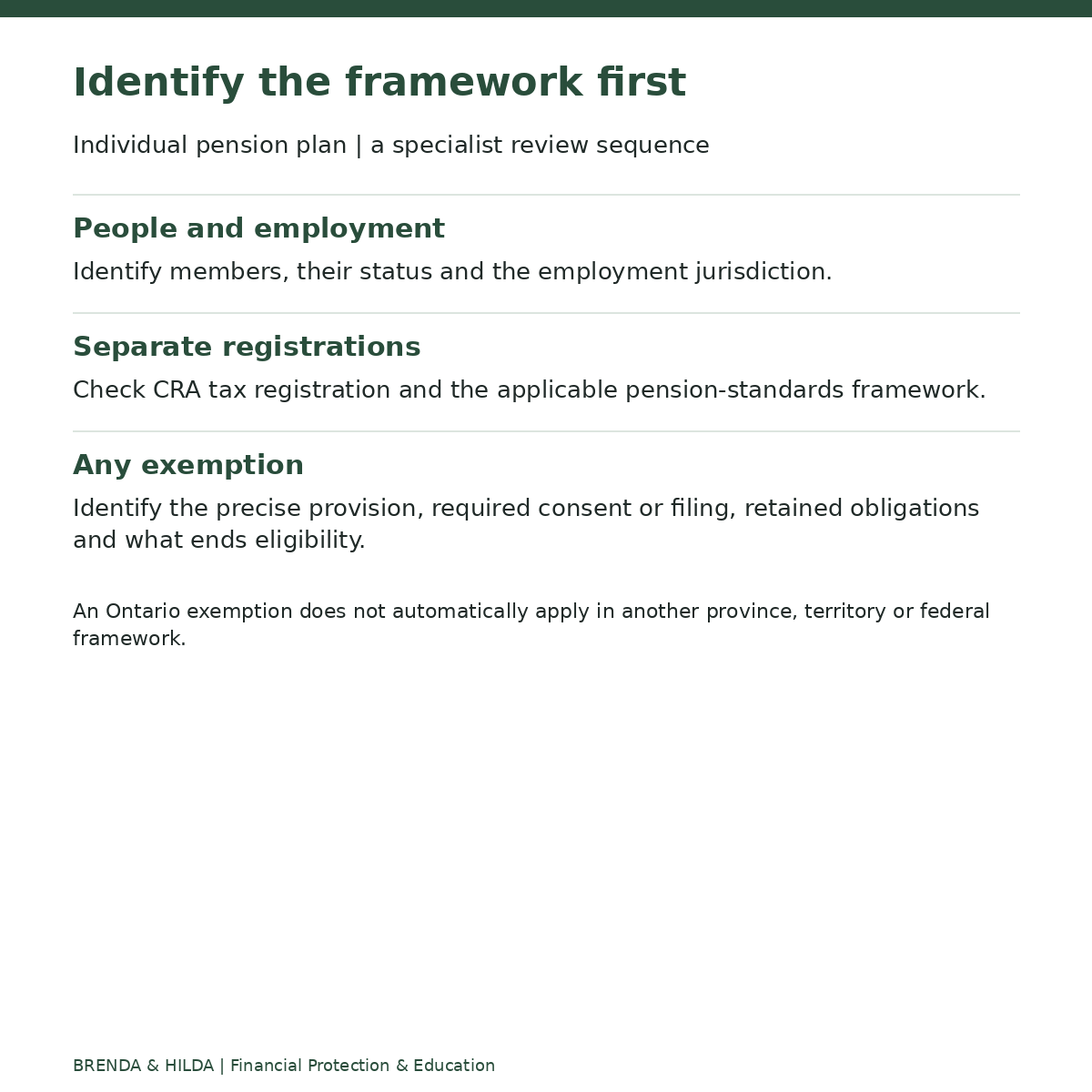
Connected person, specified individual, individual pension plan and designated plan are different definitions. A provision that refers to one term cannot automatically be applied using another. Exemptions may retain spouse, benefit-payment or other protections. The written specialist comparison should identify the exact provision, the filing or consent required, what remains regulated and what happens if another person joins the plan. Sources checked October 15, 2026.
The practical sequence is to identify the employment jurisdiction and members, obtain the proposed plan and remuneration history, confirm tax registration conditions, and then obtain written advice on any pension-standards exemption. Funding, spouse rights, locking-in and termination must be checked under that actual framework. A large deduction or the owner’s home address does not settle those questions.
For the personal account side of that comparison, the TFSA, RRSP and FHSA article explains why an RRSP dollar ceiling is different from a person’s available contribution room.
Sources
[1] CRA, Newsletter 21-1: conditions applicable to IPPs and designated plans and registered pension plan guide.
[2] CRA, pension adjustment guide.
[3] FSRA, IPP and designated-plan exemption guidance and exemption questions and answers. Rules checked October 14, 2026.
About your advisor
Brenda Nkwocha and Hilda Chukwu are licensed life insurance advisors in Ontario. Personal recommendations and quotes follow a separate needs analysis. This article provides general education, not personalized advice, a quote or a guarantee.
Choose a starting point that fits your situation.
Answer a few questions about your existing arrangements and what to check. A summary is not a needs analysis or a recommendation.