Term or whole life? Start with how long the financial obligation lasts


A term vs whole life insurance comparison starts with the obligation and its duration. A mortgage may end in twenty years. A child’s financial dependence may end earlier or later. A lifelong dependant or an estate obligation may have no predictable end date. These are different planning problems, even when all are described as a need for life insurance.[1]
Term insurance and whole life coverage provide different ways of insuring a death benefit. A useful comparison starts with the obligation and how long it is likely to exist, then examines whether the household can sustain the premiums.
How long does term insurance provide coverage?
Term insurance provides coverage for a defined term while the policy remains in force. A level-term contract may keep the death benefit and premiums unchanged during that term. The renewal schedule can require substantially higher premiums later, and renewal rights end at the contractual age or date.[1]
If no death claim occurs, the policy still provided insurance during those years. Term insurance is generally not intended to create cash surrender value. Its purpose is to transfer a defined risk during the covered period.
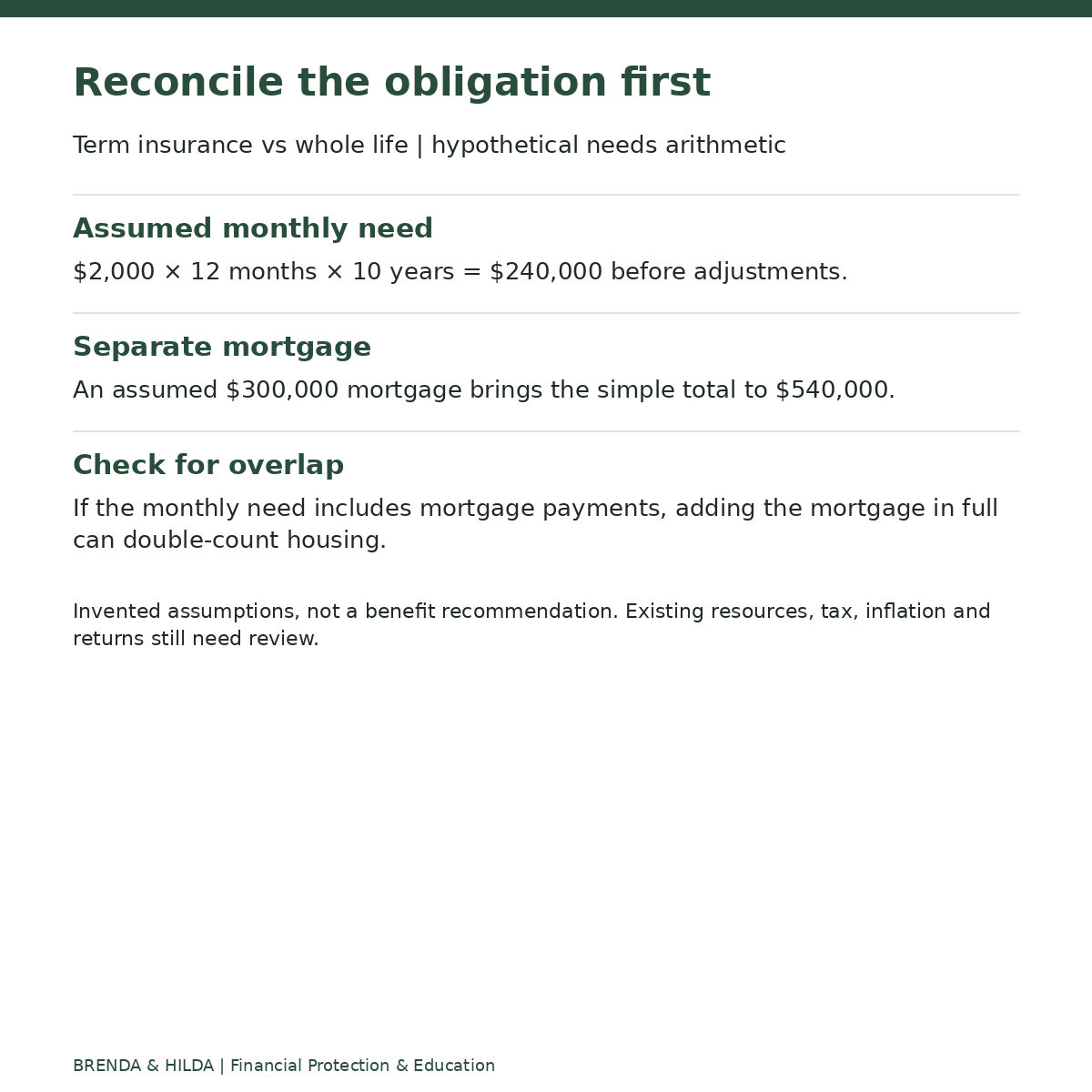
Hypothetical example: a household estimates that an extra $2,000 a month would be needed for ten years after a parent’s death. Simply multiplying gives $240,000. Paying a separate $300,000 mortgage would bring those two assumed needs to $540,000 before considering savings, existing coverage, taxes, inflation or investment returns. If the $2,000 already includes mortgage payments, adding the whole mortgage again can double-count housing. A needs analysis has to reconcile that overlap.
Whole life can cover a lasting need
Whole life is intended to provide coverage throughout the insured’s life, subject to required premiums and other terms. It commonly has guaranteed cash values, with non-guaranteed dividends possible on participating policies. For comparable initial death benefits, premiums are generally higher than term premiums at the outset.[1]
The ability to maintain the policy matters. A permanent policy surrendered early can return substantially less than the premiums paid. A larger projected value in later years does not solve an unaffordable payment today.
Other permanent forms, such as universal life, have different cost and funding provisions. Whole life and universal life should not be used as interchangeable names for every permanent arrangement.
What is the difference between term insurance renewal and conversion?
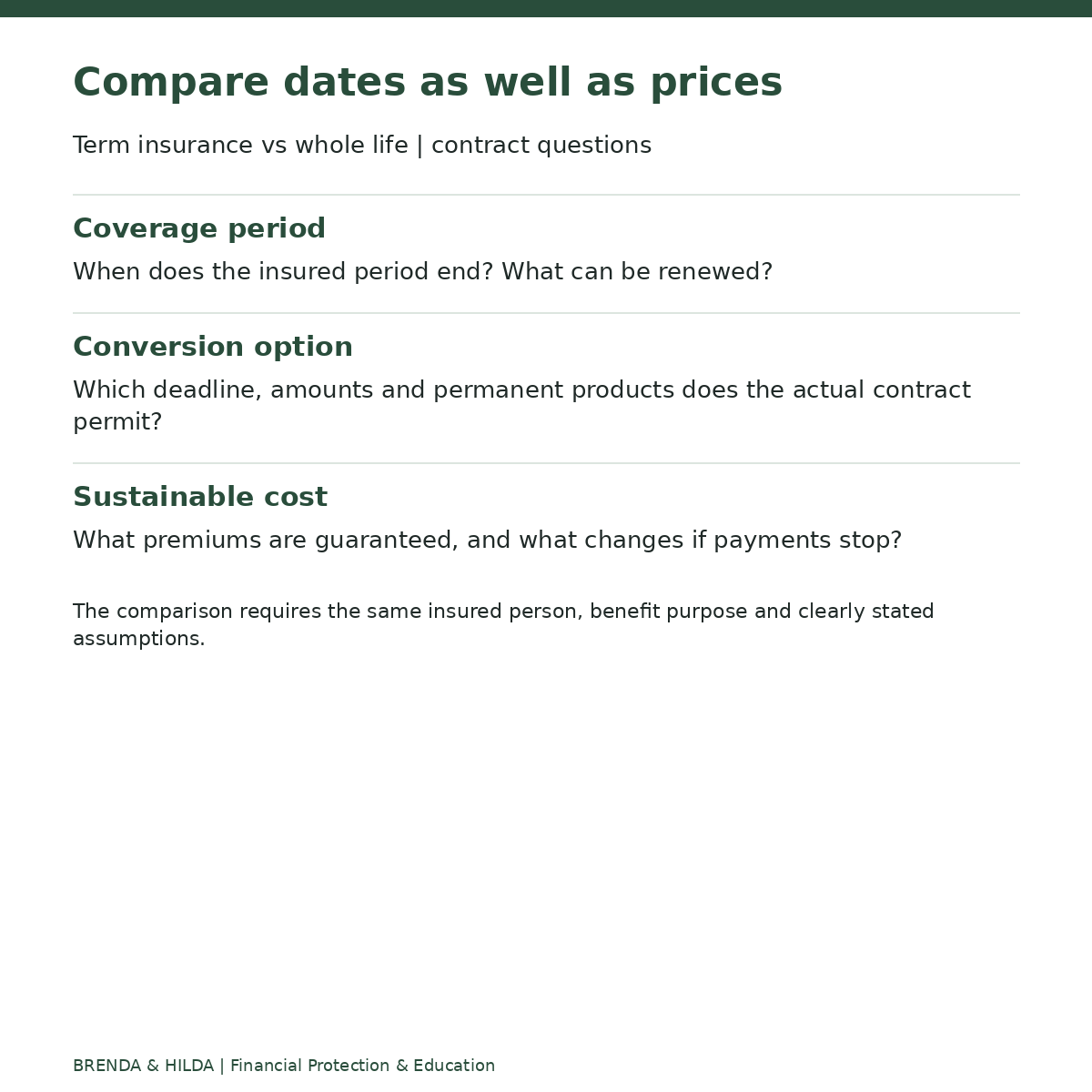
A renewal right can extend term coverage without new proof of insurability, within the contract’s limits. The price may change according to a schedule. A conversion right can permit a change to eligible permanent coverage without new medical evidence, again within specified dates, ages, amounts and products.[1]
Hypothetical example: an assumed term contract permits conversion until age 65. A health change at 58 does not automatically remove that contractual option, but waiting past its deadline can. The converted policy’s premium is determined under the conversion terms; it is not a promise to keep the original term premium.
Record the term insurance conversion deadline separately from the term expiry. They need not be the same date. Obtain the eligible products and a current conversion quote before comparing that route with a new medically underwritten application.
Term vs whole life insurance: is either always better?
There is no answer that follows from the product name alone. How long does term insurance provide coverage? and generally costs less initially for comparable protection. Whole life is intended to continue for life and commonly has cash values, with a larger initial premium commitment. The comparison changes with the amount needed, how long it is needed and what the household can keep paying.[1]
A need that lasts for ten years and a need expected to last a lifetime should not be treated as identical. The separate discussion of whole life guarantees and illustrations explains why projected values need their own review.
A comparison needs consistent assumptions
Compare the same insured person, benefit amount, underwriting class and intended period. Show initial and renewal premiums, guaranteed values and the consequences of stopping payments. If a proposal assumes investing premium savings elsewhere, the savings, investment discipline, fees and returns should be stated rather than treated as assured results.
Some households have both temporary and lasting needs. That calls for an explanation of the amount assigned to each purpose, rather than a rule that everyone should buy one type. Bring existing coverage and a reconciled expense list to the needs analysis before replacing a policy or choosing a new one.
What changes when the household lives in another province?
The comparison between a temporary obligation and a lasting one does not establish a province-specific product recommendation. The period of cover, renewal prices, conversion deadline and cash values belong to the actual contract. Product availability and the authority to advise or sell must be checked in the relevant province or territory.
Quebec: naming a married or civil-union spouse as beneficiary is generally presumed irrevocable unless the designation says otherwise. The AMF distinguishes that spouse from a de facto or common-law partner. Consent can therefore be needed to change a designation that someone assumed was freely changeable. Divorce and the dissolution of a civil union also have specific consequences. AMF: beneficiary designations and relationship changes.
Other provinces and territories: Alberta, British Columbia, Manitoba, New Brunswick, Newfoundland and Labrador, Nova Scotia, Ontario, Prince Edward Island, Saskatchewan, Northwest Territories, Nunavut and Yukon have their own insurance and estate laws. Establish whether the actual designation is revocable or irrevocable, whether there is an assignment and whether a minor is involved. Quebec’s marital presumption must not be presented as the rule for those jurisdictions. The FCAC directory of provincial and territorial regulators identifies the local authority.
For children receiving a death benefit, the age of majority is 18 in Alberta, Manitoba, Ontario, Prince Edward Island, Quebec and Saskatchewan, and 19 in British Columbia, New Brunswick, Newfoundland and Labrador, Nova Scotia, Northwest Territories, Nunavut and Yukon. That is distinct from the terms allowing a policy on a child’s life to continue or be converted. Federal age-of-majority table. A life policy, a beneficiary designation and an estate arrangement need coordinated review; one does not replace the others.
How do you compare term insurance and whole life using the same need?
Write the obligation, estimated amount and expected end date before looking at prices. In the invented example above, $2,000 a month for ten years equals $240,000 before adjustments. The separate $300,000 mortgage produces a simple total of $540,000 only if housing has not already been included in the monthly figure. This is a starting calculation, not a recommended benefit. Savings, existing insurance, taxes, inflation and the family’s actual plans still need to be reconciled. A term insurance quote cannot resolve an expense counted twice.
What should a term insurance renewal comparison show?
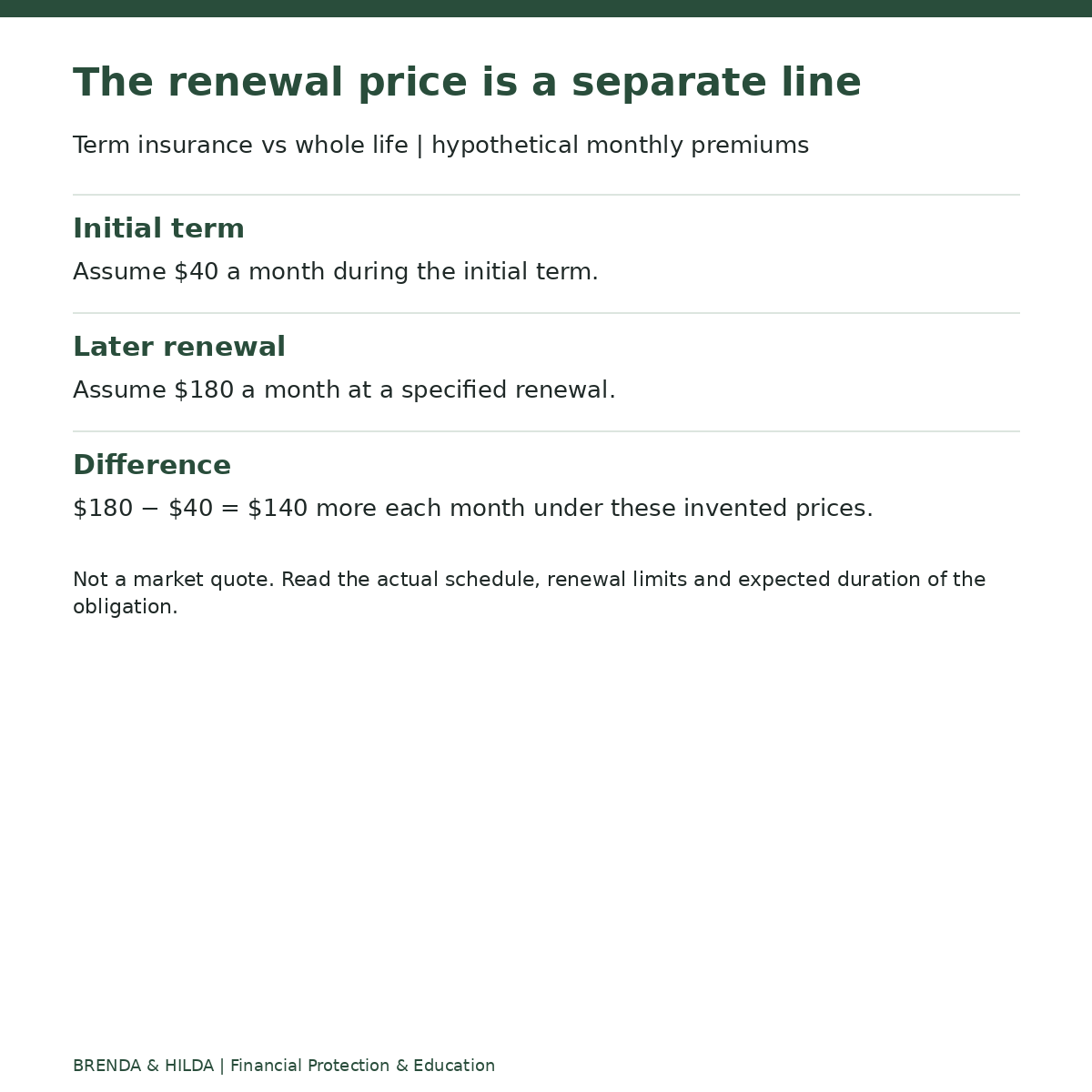
Use the actual schedule for the same insured person and coverage amount. An invented example might show $40 a month during an initial term and $180 a month at a later renewal. That is a $140 monthly difference under those assumed prices. It is not a market quote or a prediction about renewal pricing. Ask when the initial price ends, what renewal periods remain and when renewal rights stop. Compare those dates with the expected duration of the obligation rather than assuming the original monthly price continues indefinitely.
How is term insurance conversion different from buying a new policy?
A contractual conversion option follows its own eligible products, limits and deadlines. A new application is a separate process. Put the actual conversion quote beside the proposed new coverage and identify the assumptions in each. In the earlier invented age-65 deadline example, a review at age 58 leaves time to ask questions that would be different after the deadline. It does not establish which route to choose. Record the term insurance conversion date separately from the policy expiry and ask for written confirmation of the available option.
What if you plan to invest the difference in premiums?
Specify the amount that would actually be saved, how long contributions would continue and what happens if the household stops investing. An invented $100 monthly difference totals $12,000 over ten years before returns, fees or taxes. That total is a contribution calculation, not an investment forecast. The term insurance and whole life comparison needs the same coverage purpose and transparent assumptions. Future investment growth and non-guaranteed policy values should both be labelled as assumptions. Neither can be treated as cash already available to a beneficiary.
Can term insurance and permanent insurance address separate obligations?
A household can have obligations with different durations. Record each purpose separately before discussing how any coverage might be structured. For example, a time-limited income-replacement need and a lasting support obligation do not automatically require the same period of cover. This observation is not a recommendation for a particular mix. Existing policies, affordability, health assessment and available contract terms matter. Ask the licensed representative to explain the amount assigned to each purpose so the term insurance component and any permanent component can be reviewed on their own merits.
What belongs in a term insurance comparison worksheet?
Use columns for the benefit, initial premium, future premium schedule, final coverage age, conversion deadline and relevant guarantees. Include the current policy rather than comparing only new applications. Ask what happens after a missed payment and what coverage would remain after a proposed change. Keep guaranteed figures separate from projections. Then review the worksheet against the reconciled household obligations. The result should be a set of reasons and questions that the family can understand, followed by personal advice only after the separate needs analysis.
Source
[1] FCAC, Life insurance; FSRA, Policy types; AMF, Choosing Life and Health Insurance (consumer guide). All numerical examples use original hypothetical assumptions.
About your advisor
Brenda Nkwocha and Hilda Chukwu are licensed life insurance advisors in Ontario. Personal recommendations and quotes follow a separate needs analysis. This article provides general education, not personalized advice, a quote or a guarantee.
Choose a starting point that fits your situation.
Answer a few questions about your existing arrangements and what to check. A summary is not a needs analysis or a recommendation.