Short-term disability: how much of your pay would actually arrive?


A short-term disability benefit booklet that says “66 2/3% of earnings” can sound like a straightforward promise. To build a household budget around it, you also need the earnings definition, maximum benefit, waiting period and tax treatment. The percentage alone does not establish the cash that will arrive.[1]
Short-term disability benefits provide temporary income support for an eligible illness or injury. Some employers use an insured plan; others pay benefits through a salary-continuance arrangement. Paid sick days may cover a separate initial period. Start by identifying which arrangement you actually have, who administers it and where a claim must be filed.
What qualifies for short-term disability in Canada?
Short-term disability eligibility comes from the employer arrangement or insurance contract. Generally, an illness or injury must prevent the work described by its disability definition. The administrator may require medical evidence, details of job duties and proof that the employee meets the plan’s coverage conditions. A diagnosis or doctor’s note does not automatically satisfy every requirement.[1][2]
For a short-term disability claim, the practical questions are which duties cannot be performed, how long the restriction may last and what evidence the plan requires. An approved short-term claim also does not settle eligibility for long-term disability benefits, where the definition and duration can differ.
How much does short-term disability pay after the cap?
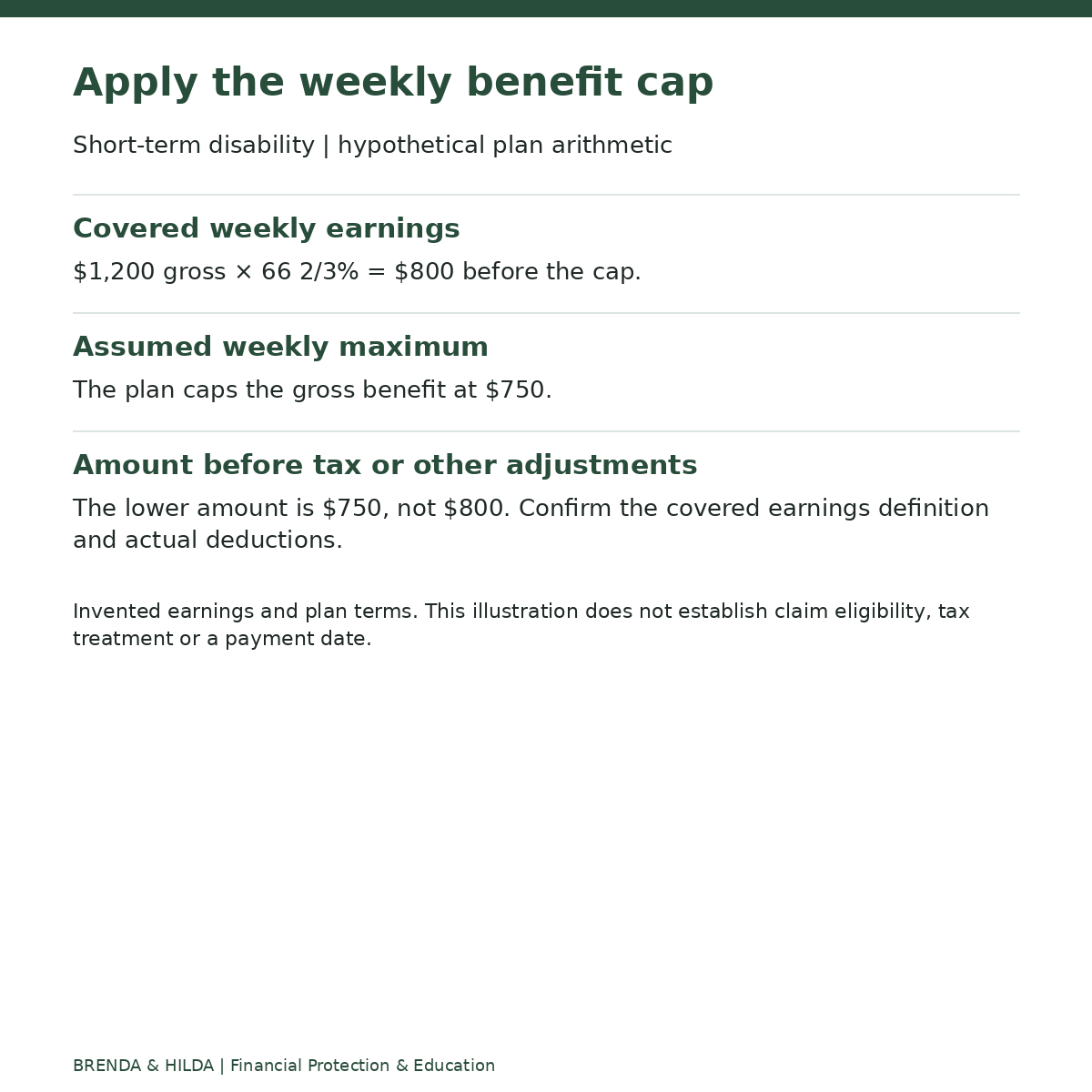
Hypothetical example: an employee earns $1,200 gross per week. Their assumed plan pays 66 2/3% of covered earnings, capped at $750 per week. Two-thirds of $1,200 is $800, so the cap reduces the gross benefit to $750. It is not an $800 payment.
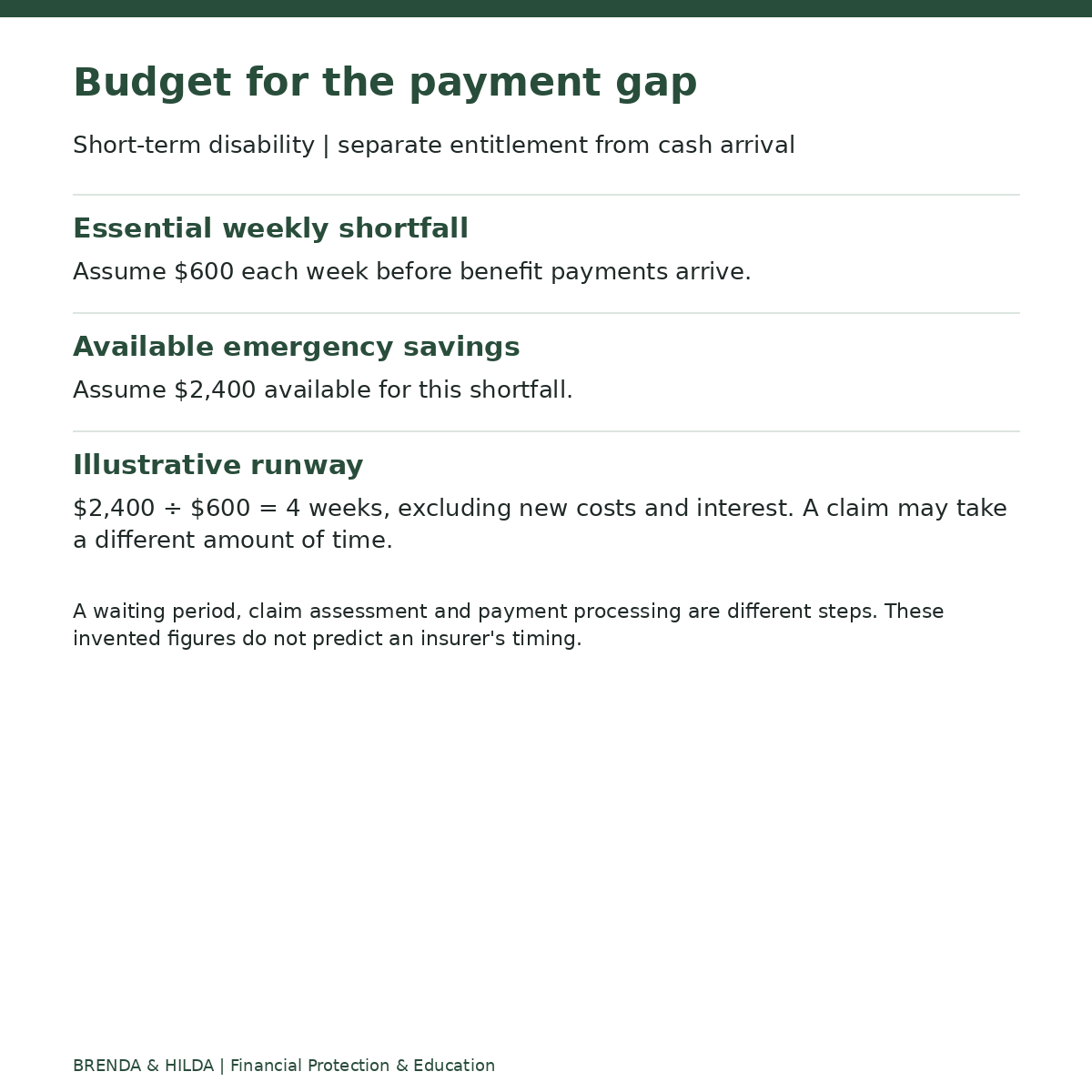
Assume the employee has $2,400 of available emergency savings and an essential household spending shortfall of $600 a week before benefits begin. Those savings cover four weeks at that spending rate. That calculation does not establish how quickly the insurer will approve or pay the claim. It also excludes new expenses, interest and investment movements.
If the short-term disability benefit is taxable, $750 gross is not the amount available to spend. Employer funding generally makes disability payments taxable; benefits from an arrangement funded entirely by employee contributions may be received tax-free. Shared funding and contribution histories require closer examination. Ask payroll or the administrator for the treatment of your specific plan.[1][2]
When does short-term disability start paying?
A short-term disability waiting or elimination period is the initial interval before benefits become payable under the plan. Claim assessment and payroll processing can take additional time. Even when an approved claim is paid retroactively, the household may have bills due before the money arrives.[1]
Check whether the short-term disability waiting period differs for illness and injury, whether sick leave must be used first and what medical evidence is needed. Keep the filing deadline and administrator’s contact details somewhere accessible. A doctor’s note may be one part of the evidence; it does not itself establish that every contractual test is satisfied.
How long does short-term disability last?
Short-term disability benefits have a maximum duration. If the condition continues, eligibility for long-term disability is assessed under that plan’s definition and other requirements. Approval of the short-term claim does not automatically approve the long-term claim.[1]
As short-term disability ends, ask when an LTD application should start and whether the two waiting periods line up. Establish what happens to coverage during a leave, layoff or employment change. A benefit that exists while actively employed may not continue indefinitely after that relationship changes.
EI sickness benefits may be relevant where employer coverage is absent or insufficient, but eligibility and coordination rules apply. Federal guidance currently allows up to 26 weeks at 55% of insurable earnings, subject to the annual maximum. That is a separate program, not a promise that EI will be added to an employer payment.[3]
What should you bring to a short-term disability review?
For a short-term disability budget, list housing, utilities, groceries, debt minimums and care costs. Set that beside the estimated benefit after applicable taxes and offsets, with a separate line for the initial waiting period. Mark unconfirmed amounts as unknown. This produces a more useful discussion than assuming the workplace plan covers everything or that a new policy must be necessary.
How the province of work affects leave and disability income
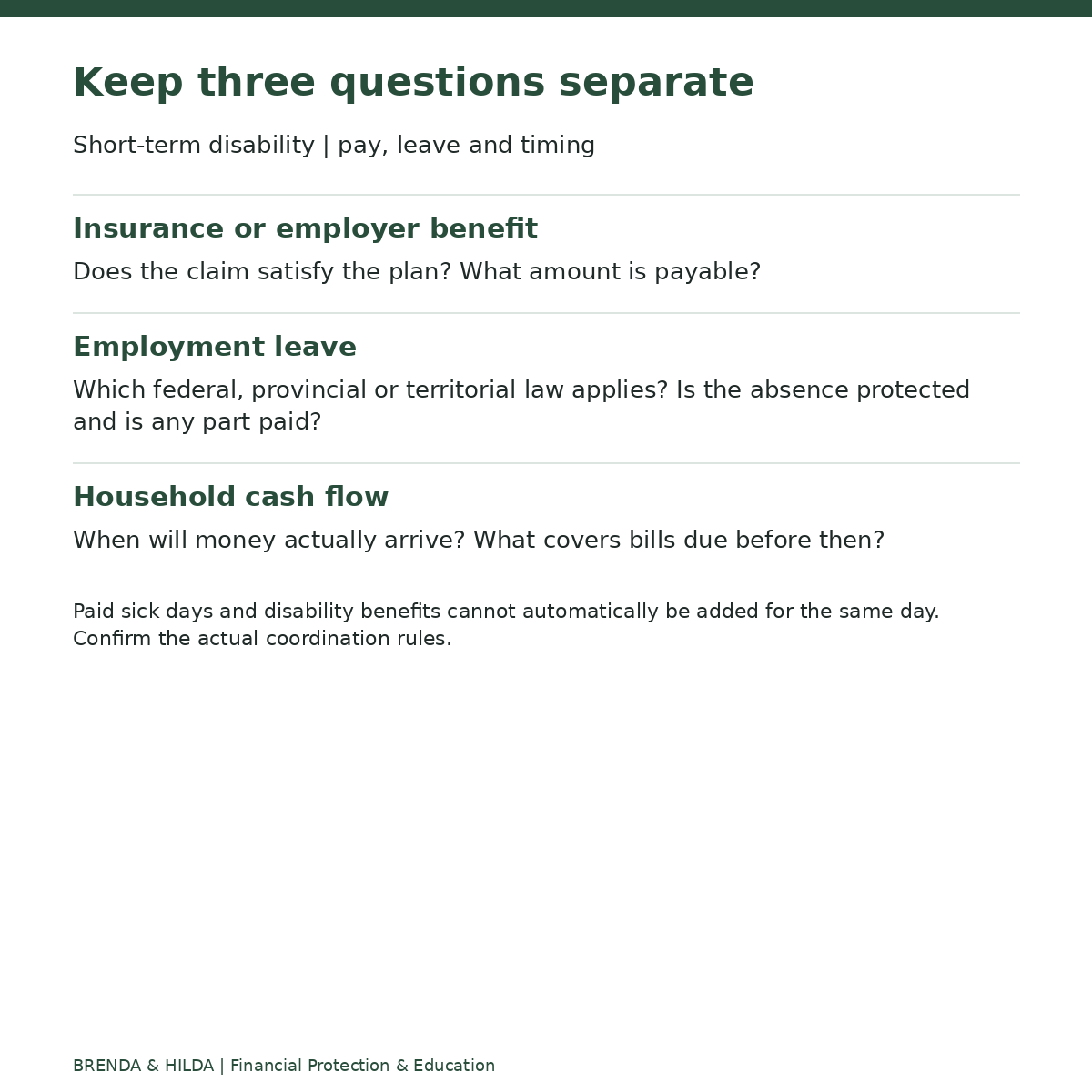
Short-term disability insurance and statutory sick leave are separate. The insurance plan decides whether a claim qualifies and how much it pays. Employment standards determine minimum leave rights, including whether a particular leave is paid. The relevant workplace law can depend on the industry as well as where the employee works. A benefit booklet cannot establish every legal leave entitlement.
For provincially or territorially regulated work, the federal government’s employment-standards directory links the authorities for Alberta, British Columbia, Manitoba, New Brunswick, Newfoundland and Labrador, Nova Scotia, Ontario, Prince Edward Island, Quebec, Saskatchewan, Northwest Territories, Nunavut and Yukon. Use the authority for the province or territory of work. Federally regulated businesses follow the applicable Canada Labour Code rules rather than assuming the province’s minimum leave applies.
EI sickness is a federal program available to eligible claimants, including those in Quebec. Quebec’s QPP disability pension is a separate program and does not cover temporary disability. It is not a replacement name for EI sickness. Service Canada: EI sickness and Retraite Québec: disability eligibility.
Short-term disability income-tax withholding also needs the actual arrangement. Revenu Québec publishes separate rules for wage-loss replacement payments and Quebec source deductions. In every province and territory, distinguish a gross plan benefit from the spendable amount rather than applying the example’s assumed tax treatment to everyone.
How many sick days are available in each province and territory?
Before short-term disability starts, the difference between paid time off and unpaid time off can change the next paycheque. The table below summarizes general employment-standards rules for covered employees, checked October 14, 2026. It is separate from the amount or duration of a disability insurance benefit. Each jurisdiction name links to its official source.
| Employment jurisdiction | General sick-leave position |
|---|---|
| Alberta | Up to 5 unpaid days per calendar year after 90 days with the employer. Personal and family responsibility leave is a shared allowance for the employee’s health and qualifying family responsibilities. |
| British Columbia | After 90 days of employment, up to 5 paid and 3 unpaid illness or injury days per calendar year. |
| Manitoba | After 30 days with the employer, 3 unpaid family-leave days per year can be used for personal illness or family responsibilities. These are not separate allowances for each purpose. |
| New Brunswick | After more than 90 days with the same employer, up to 5 unpaid sick days during a 12-month period. |
| Newfoundland and Labrador | After 30 continuous days with the same employer, 7 unpaid days per year are shared between sick leave and family responsibility leave. |
| Nova Scotia | Up to 5 unpaid days per year for the employee’s illness or injury. A separate 3 unpaid days cover family illness and medical or similar appointments for the employee or family member. |
| Ontario | After 2 consecutive weeks with the employer, up to 3 unpaid sick days per calendar year for personal illness, injury or medical emergency. |
| Prince Edward Island | After 30 days with the same employer, up to 4 unpaid sick days per 12-month period. Paid entitlement is 1 day after 12 months of continuous service, 2 after 24 months and 3 after 36 months, per 12-month period. |
| Quebec | The first 2 qualifying absence days per calendar year are paid after 3 months of uninterrupted service. This is one shared paid allowance across illness, certain family obligations and other listed reasons. Non-work-related illness or injury absence can be protected for up to 26 weeks in a 12-month period; the remainder is generally unpaid. |
| Saskatchewan | For employees with more than 13 consecutive weeks of service, protection covers up to 12 days per calendar year for non-serious illness or injury. The legislation does not provide paid sick leave. Serious illness or injury has a separate protection of up to 27 weeks in 52 weeks. |
| Northwest Territories | After at least 30 days with the employer, an employee unable to work because of illness or injury is entitled to at least 5 unpaid sick days per 12-month period, subject to the Act’s request and evidence rules. |
| Nunavut | The Labour Standards Act linked by the territory does not set a general sick-day allowance for the employee’s own illness. Employment terms and applicable human-rights obligations need separate review. Government employee sick-leave policies cannot be assumed to apply to all Nunavut workers. |
| Yukon | Unpaid sick leave accrues at 1 day for each month of employment, up to a maximum of 12 days, reduced by sick leave already used. This is an accrued entitlement, not a fresh 12 paid days. |
| Federally regulated workplaces in any province or territory | Paid medical leave accrues under the Canada Labour Code: 3 days after 30 continuous days, then additional monthly accrual up to 10 days per year. Unpaid medical-leave protection can extend to 27 weeks. The federal rules apply because of employment jurisdiction, not because an employee receives EI. |
These short-absence figures are not a ceiling on every form of protected absence. Several jurisdictions have separate longer medical leaves with their own service, certification and timing conditions. For example, Ontario’s long-term illness leave can provide up to 27 unpaid weeks in a 52-week period for an eligible employee with at least 13 consecutive weeks of service and the required certificate. British Columbia’s serious personal illness or injury leave has no minimum service period. Those two rules cannot be treated as interchangeable.
An employment contract or collective agreement may provide more. Some contractual leave can count toward the statutory entitlement, so the two figures cannot automatically be added. Coverage exclusions, notice, evidence, disability accommodation and return-to-work rights also require separate attention. A limit on an employer’s request for a sick note does not establish what medical evidence an insurer may require for a benefit claim.
What does a paid sick day change in the household budget?
Hypothetical example: two employees each miss five scheduled workdays and ordinarily earn $200 gross per day. Assume the first qualifies for five paid sick days in British Columbia and has not used them. The second qualifies for Ontario’s three unpaid statutory sick days and has no employer-paid benefit. The first may receive $1,000 gross for the five eligible paid days. Ontario’s short sick-leave provision alone supplies no replacement wages and does not itself establish protection for the full five-day absence. Another leave or arrangement may apply. These are invented earnings and simplified circumstances, not a prediction of either employee’s full legal position.
For a short-term disability cash-flow comparison, record statutory paid days, any employer benefit and an insurer’s waiting period separately. Confirm how the arrangements interact before assigning money to the same day twice. An unpaid leave can preserve employment while leaving the household with no pay from that leave.
Sources
[1] FCAC, Disability insurance.
[2] FCAC, disability insurance.
[3] Service Canada, EI sickness benefit amounts. Program figures checked October 14, 2026.
About your advisor
Brenda Nkwocha and Hilda Chukwu are licensed life insurance advisors in Ontario. Personal recommendations and quotes follow a separate needs analysis. This article provides general education, not personalized advice, a quote or a guarantee.
Choose a starting point that fits your situation.
Answer a few questions about your existing arrangements and what to check. A summary is not a needs analysis or a recommendation.