Life insurance for children: what is covered now, and what can be bought later?


Child life insurance can combine several ideas: a death benefit now, coverage that may continue into adulthood, a right to buy more later and possible cash values. They need separate explanations. Buying a policy today does not create an unlimited right to obtain any amount of insurance in the future.[1]
The first question is what financial need the household intends to address. Expenses after a child’s death, a parent’s time away from work and a wish to preserve specific future purchase options are different purposes. None should be assumed from the child’s age alone.
What does child life insurance cover now?
An existing child life insurance policy can continue under its terms and required payments. A later health change does not, by itself, turn the original benefit into a larger one. Any right to add coverage comes from a specific rider or conversion provision.[1]
A child life insurance guaranteed-insurability rider may permit additional purchases without new medical evidence at specified dates or events. It can limit the amount per purchase, the total increase, the number of opportunities and the final eligible age. New coverage still has a premium determined under the rider’s terms.
Hypothetical example: an assumed rider allows a $25,000 additional purchase at each of four specified dates. Exercising all four options could add $100,000, subject to the rider’s requirements and payment of new premiums. That is not a right to buy $1 million whenever the insured chooses. Missing a purchase window may also have consequences under the rider. These amounts and opportunities are invented; the actual schedule must come from the contract.
A child rider on a parent’s policy is another arrangement. Check whether it can be converted to individual coverage, the deadline and benefit limits, and what happens if the parent’s base coverage ends. It should not be described as identical to an individually owned permanent policy.[1]
What is a child life insurance rider?
A child rider adds coverage for an eligible child under another insured person’s policy, often a parent’s. It is different from a separate policy on the child’s life. The rider specifies who is covered, the benefit and when coverage ends. If conversion to an individual policy is available, its deadline and limits come from that provision.[1]
A rider’s conversion right and a guaranteed-insurability option are also different promises. The first concerns changing existing coverage; the second may permit specified additional purchases. Neither description establishes an unlimited right to any amount of insurance later.
How do child life insurance values differ from education savings?
A whole life policy may accumulate guaranteed cash surrender values. Participating policies can also illustrate non-guaranteed dividends and additions. The illustrated total is not a guaranteed investment return, and early surrender can return much less than the premiums paid.[1]
Hypothetical budget comparison: $50 a month equals $600 a year. Committing that amount to insurance assigns it to the policy’s coverage and contractual values. Putting the same amount into a savings arrangement follows that account’s investment, access and tax rules. Equal contributions do not produce equal benefits or prove either choice is better. A fair comparison needs actual guaranteed policy values, fees, eligibility for any education-savings incentives and the date the family expects to use the money.
Borrowing against a policy adds interest and other risks. Surrender or other transactions can affect the death benefit and create tax consequences. A description such as “money for university” should explain exactly how the owner would obtain it and what would remain afterward.
How does child life insurance fit the family’s payment obligations?
Children often depend on adult income and unpaid caregiving. Existing adult life and disability coverage, emergency resources and expensive debt all affect what the family can sustain. A household needs analysis helps identify these obligations; an income multiple cannot settle the answer for every household.[1]
Establish who owns the child’s policy, who pays premiums and who receives a death benefit. Reaching adulthood does not necessarily transfer ownership automatically. A parent/payor waiver benefit, if offered, has its own insured event, waiting period and expiry conditions. It should not be assumed to cover every reason a parent becomes unable to pay.[1]
Before deciding, request a one-page explanation separating existing coverage, future purchase rights, guaranteed values and non-guaranteed projections. Put the premium beside the family’s other commitments. A personal recommendation can then address the purpose and affordability without treating a child’s policy as a universal starting point.
Age, ownership and a child’s money differ across provinces
| Provinces and territories | Age of majority |
|---|---|
| Alberta, Manitoba, Ontario, Prince Edward Island, Quebec and Saskatchewan | 18 |
| British Columbia, New Brunswick, Newfoundland and Labrador, Nova Scotia, Northwest Territories, Nunavut and Yukon | 19 |
The federal age-of-majority table explains those age groups. Reaching that age does not automatically transfer ownership of a parent’s policy to the child. The policy’s ownership and any actual transfer arrangement need separate examination.
Quebec’s tutorship rules apply when a minor owns property or receives a life insurance benefit. They include duties for tutors and oversight in specified circumstances. A generic suggestion to name a trustee should not be presented as a substitute for Quebec’s legal framework. In the other provinces and territories, the applicable trustee, guardianship and payment-to-minor rules must be reviewed under local law. Official provincial and territorial insurance-regulator directory.
These ownership and minor-beneficiary questions are separate from whether a child rider can be converted or additional insurance purchased later. Those rights remain subject to the contract’s amounts, dates and conditions. The relevant age on a rider schedule is not automatically the province’s age of majority.
The whole life cash-value explanation also applies to understanding a child’s permanent policy: guaranteed values and dividend projections need separate columns.
How do you compare a child life insurance rider with a separate policy?
Use a separate row for each arrangement. Record whose life is insured, who owns the coverage, who pays, the stated benefit and the final coverage date. Then identify any conversion or additional-purchase right in its own column. A rider attached to a parent’s policy and a separate policy on the child may differ on all of those points. Ask for the actual clauses, including what happens if the parent’s coverage ends. The lower monthly price cannot answer those questions by itself.
How much future coverage does the hypothetical option actually provide?
The invented rider above permits four additional purchases of $25,000, giving a maximum of $100,000 in additional insurance if every condition is met and every option is used. Suppose, separately, that the assumed existing benefit is $50,000. The simple total after all four purchases would then be $150,000. That is arithmetic under invented terms. It does not establish the child’s future need, the price of each purchase or a right to any other amount. A child life insurance review should distinguish the existing benefit from the maximum additional benefit.

Which child life insurance dates should go on a calendar?
Use the issued contract to identify any rider expiry, conversion deadline and additional-purchase windows. Add the date a required notice must reach the insurer where the clause specifies one. Ask what happens after a missed window and how a later purchase premium is determined. The relevant contractual dates may differ from the age when a child reaches majority in the province or territory. Keep the owner and payor contact details current with the insurer so important correspondence has a clear destination. A calendar helps organize the terms; it does not change them.
How do you compare child life insurance values with a savings goal?
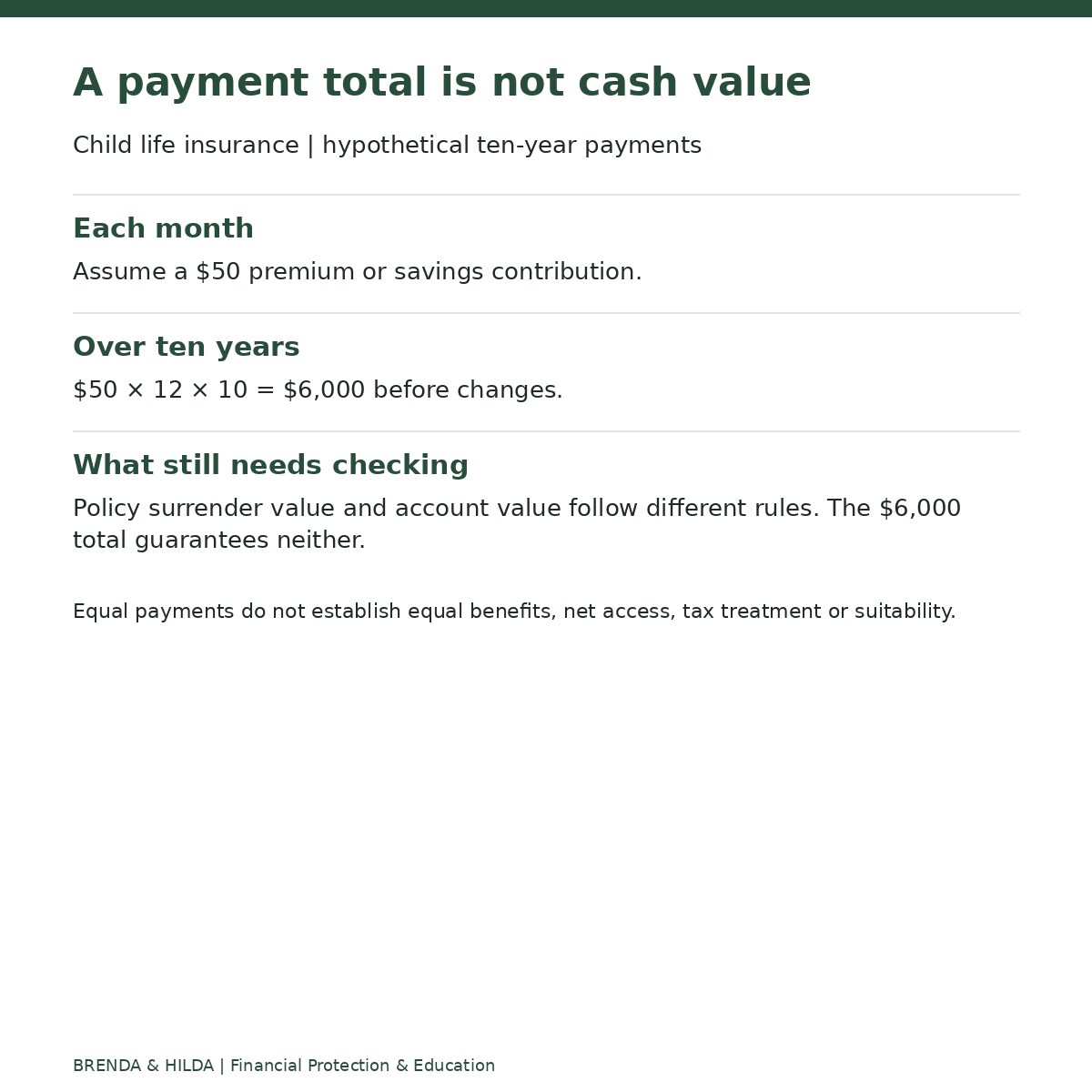
State the goal and the date when money would be needed, then compare the actual access rules and values. The invented $50 monthly payment above totals $6,000 over ten years before any changes. That is a premium or contribution total, not a guaranteed amount available for education. Request the guaranteed surrender value at the intended date and identify any projection separately. For a savings arrangement, identify its own fees, investment assumptions and tax rules. Equal monthly payments cannot establish equal net access to money or equal benefits.
What should a child life insurance ownership review record?
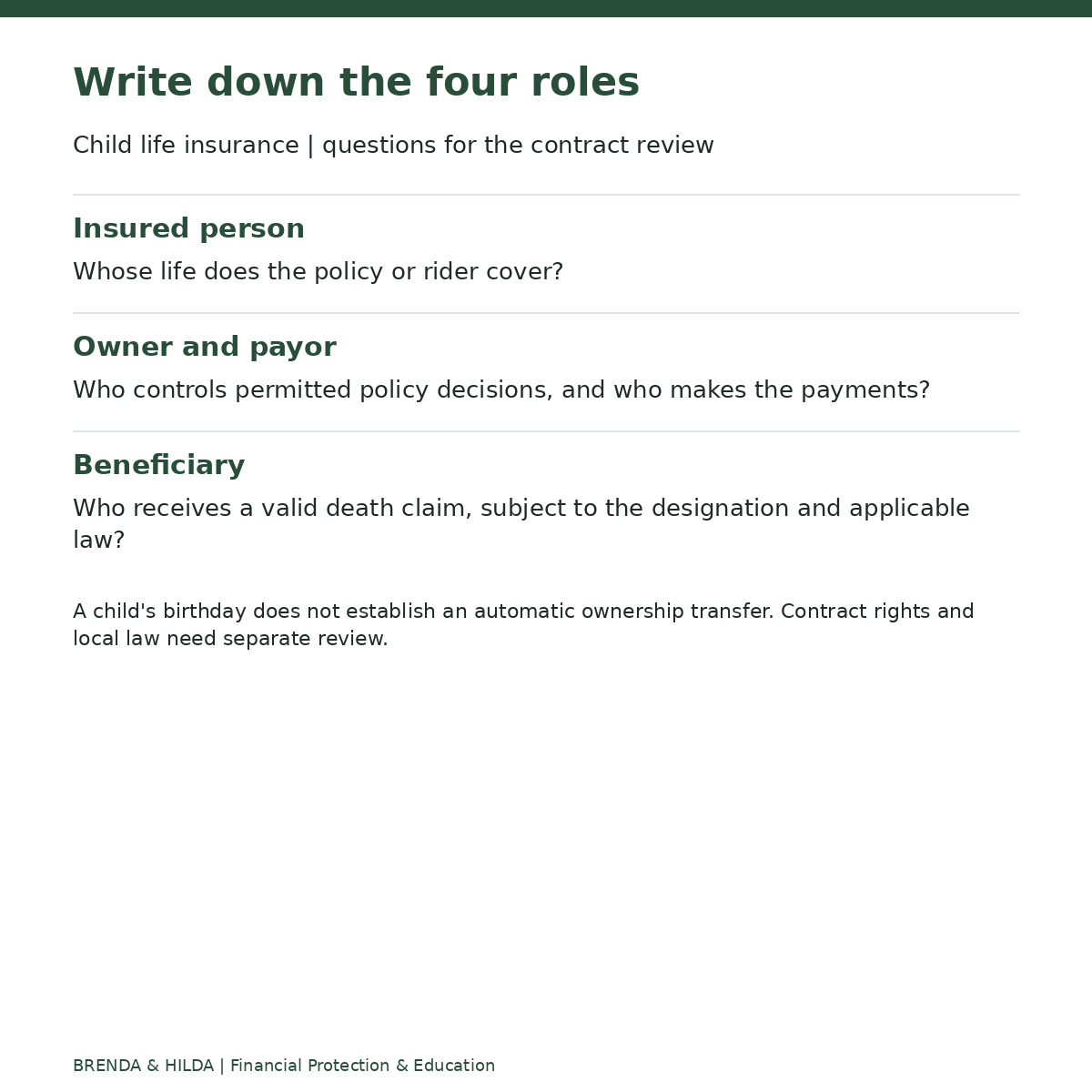
Write down the legal policy owner, the insured person, the premium payor and each beneficiary. These roles can belong to different people. Ask who can request information, change permitted terms or authorize a transaction under the actual arrangement. If a transfer is intended later, obtain advice on its process and consequences rather than assuming a birthday completes it automatically. Record where the policy and amendments are kept. This is document preparation, not a recommendation for a particular ownership, trust or beneficiary structure.
What is a useful next step before deciding about child life insurance?
Bring the existing adult and child coverage, household obligations, savings goals and proposed policy terms to a separate needs analysis. Identify the purpose of each possible benefit and what is already funded. Mark unanswered questions about cost, dates, ownership and guaranteed values clearly. The result may be a better understanding of the existing arrangements without a purchase. If new child life insurance is considered, the licensed representative should explain its role and affordability using the household’s actual circumstances. This educational article does not recommend a policy or benefit amount.
Source
[1] FCAC, Life insurance; AMF, Participating and non-participating whole life insurance; AMF, Accessing cash surrender value; AMF, Choosing Life and Health Insurance (consumer guide); AMF, Becoming a parent. Rider amounts and purchase windows in the example are hypothetical contract assumptions, not standard terms or an insurer quote.
About your advisor
Brenda Nkwocha and Hilda Chukwu are licensed life insurance advisors in Ontario. Personal recommendations and quotes follow a separate needs analysis. This article provides general education, not personalized advice, a quote or a guarantee.
Choose a starting point that fits your situation.
Answer a few questions about your existing arrangements and what to check. A summary is not a needs analysis or a recommendation.